
Then it routed every query through the wrong tool — consistently, confidently, and without any error message to explain why.
The first assumption is almost always the same: the model isn’t smart enough. That assumption is wrong. And it wastes time chasing a problem that doesn’t exist.
The 30-Second Tool Precision Scan
- The Generalist Default: If your tool is simply named “Search,” the agent will use it as a hammer for every nail. This isn’t a model failure; it’s a labeling failure.
- Invisible Rerouting: Every time an agent picks the wrong tool, a human eventually has to step in to fix the result. That’s a “labor tax” you’re paying for lazy descriptions.
- Negative Constraints: A great description doesn’t just tell the agent what the tool does—it defines the exact boundaries of when it is forbidden to use it.
- ROI of Determinism: Moving from “probabilistic guessing” to “reliable routing” is what allows an automation to scale without doubling your oversight team.
The Root Cause Is One Layer Upstream
LangChain agents select tools based on the name and description fields in your tool schema. When a query arrives, the agent reads those fields and constructs a tool call with the name and structured arguments it believes best match the task.
This is not a black box. It is a semantic matching process. The agent is doing exactly what it should — reading what you wrote and making a decision. The problem is that most tool descriptions are written to explain what the tool does, not to constrain when it should be used.
That distinction matters more than anything else in this fix.
A description like “Searches for information” tells the agent nothing about when NOT to use this tool. A description like “Retrieves records from internal structured data” is slightly better but still leaves the boundary fuzzy. The agent has no reason to choose one over the other if both could plausibly apply.

Before and After: The Schema Rewrite
This is the pattern that breaks most agents. The descriptions look reasonable in isolation. Side by side, they are indistinguishable to a language model trying to route a query.
Before — Ambiguous Descriptions
Tool 1
name: Search
description: “Useful for searching and finding information.”
Tool 2
name: Database
description: “Retrieves data from the database.”
After — Constrained Descriptions
Tool 1
name: Search
description: “Use this ONLY for retrieving publicly available, real-time, or external web information where no structured internal record exists. Do NOT use this for queries about internal users, orders, products, or stored records.”
Tool 2
name: Database
description: “Use this ONLY when the query references internal structured data: user records, order history, product inventory, or any stored entity. Do NOT use this for general knowledge, current events, or external content.”
The rewrite does two things the original didn’t: it tells the agent what to use the tool for, and it explicitly tells the agent what NOT to use it for. Both halves matter. The exclusion clause is what prevents the agent from defaulting to the broader-sounding option.
The Scenario That Exposed This
Here is what the failure flow looked like in practice.
A user query arrives asking about a customer’s recent order status. The agent has Search and Database available. The descriptions are vague. The agent reads both, determines that “order status” could plausibly be searchable information, and calls Search. The tool returns nothing useful. The agent either loops, hallucinates an answer, or returns an error.
The assumption at this point: the model needs a better base prompt, or a smarter model entirely.
The actual fix: rewrite the Database description to include “Use this when the query references a specific customer, order ID, or internal record.” Rewrite the Search description to include “Do NOT use this for internal record lookups.”
Same model. Same base prompt. Correct tool selected on the next run.
The working flow: User query about order status → agent reads constrained tool descriptions → routes to Database tool → structured query executes → result returned cleanly. No model swap required.
Why the Default Tool Templates Make This Worse
Some LangChain agent templates are built around the assumption that tool use is always the right move. Certain base templates include instructions that push the model toward function calls regardless of whether a tool is actually needed. This compounds the selection problem: the agent is already biased toward tool use, and if the descriptions don’t create clear routing lanes, it picks the path of least semantic resistance.
The fix is not to fight the template. The fix is to make the descriptions so specific that the routing becomes deterministic even inside a tool-biased template.
There is also the strict JSON validation angle. When agents bind tools with strict schema validation, any mismatch between the expected input schema and the tool’s actual input structure causes silent failures or unexpected fallbacks. Tool descriptions and input schemas need to be consistent — the description defines when to call the tool, and the input schema defines what to pass when calling it. Both layers matter.
The Profit Angle
You don’t have a model intelligence problem. You have someone silently re-routing failed agent outputs by hand every day — and that correction loop never shows up in your automation metrics.
The Operational Cost You’re Not Tracking
What Tool Selection Bias Costs in Practice
Wrong tool selected
Constrained schema → correct routing
Irrelevant or empty results — requires human review
Structured result returned — no manual correction needed
Roughly one manual intervention per N failed calls — invisible overhead
Selection becomes reliable across query types without human gates
Chasing model capability → wrong direction entirely
Schema audit → fix in one place → propagates across all agent calls
What This Does Not Solve
Tightening tool descriptions fixes selection bias. It does not fix everything.
If your tools have genuinely overlapping domains — two tools that both legitimately handle similar query types — description constraints alone won’t fully eliminate ambiguity. You will need routing logic upstream, such as an intent classification step before the agent even sees the tools.
Description fixes also don’t help when the agent loops because it receives a valid tool result but doesn’t know when to stop. That is a termination problem, not a selection problem. The root cause is different, and the fix is different.
And if your tool’s input schema is inconsistent with the description — for instance, the description says the tool handles order lookups but the input schema only accepts a generic query string with no structure — you will still get malformed calls even after the routing improves. The description tells the agent when to call the tool. The input schema tells it how. Both need to be coherent.
The Practical Checklist Before You Ship a Multi-Tool Agent
Not a generic list. These are the specific places where tool selection breaks in production.
- Every tool description includes a “Use this ONLY when…” clause. Not just what it does — when to use it.
- Every tool description includes a “Do NOT use this when…” clause. Exclusions are as important as inclusions.
- Tool names are unambiguous.
Searchas a name invites broad use.ExternalWebSearchorInternalRecordLookupcreates friction in the right direction. - Input schemas match the description’s implied scope. If the description says “structured internal records,” the input schema should reflect that with typed fields, not a generic freeform string.
- You have tested with queries that could plausibly match multiple tools. Edge cases reveal selection bias faster than happy-path tests.
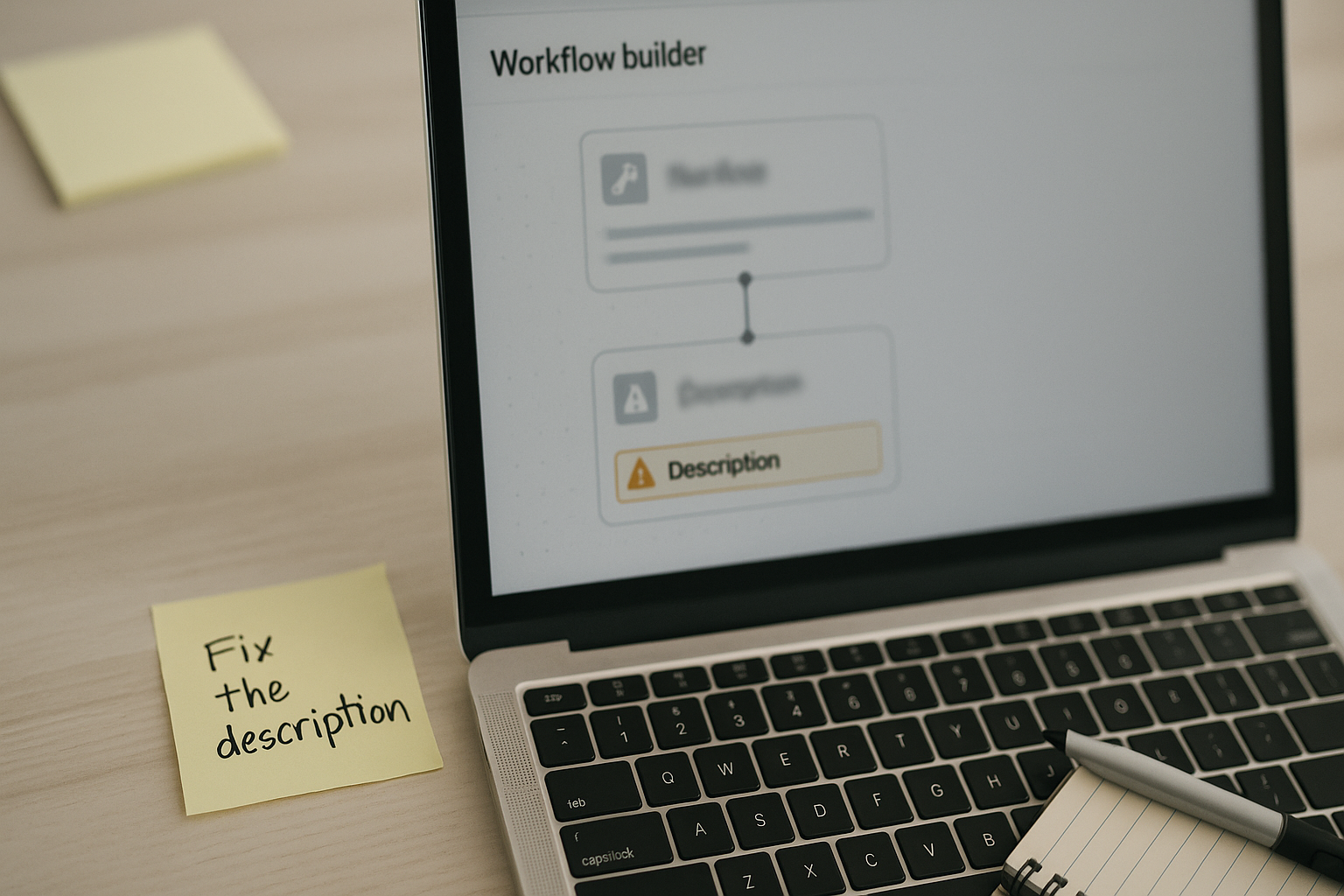
What the Failure Actually Looks Like
The agent has two tools available. One is a Search tool for pulling live web content. The other is a Database tool for querying structured internal records. The query comes in. The agent picks Search. Every time.
You check the model. You check the prompt. You wonder if the LLM just isn’t capable of distinguishing between the two. You might even swap models, which changes nothing.
Here is what is actually happening: the agent is reading both tool descriptions and making a probabilistic judgment about which one best fits the query. If both descriptions are vague, the agent defaults to whichever one sounds more broadly applicable. Search usually wins that contest because the word itself implies general-purpose use.
The model isn’t confused. The schema is ambiguous. Those are different problems with different fixes.
Decision Snapshot
Best for: Teams running multi-tool LangChain agents where one tool keeps getting selected over others.
Avoid if: Your agent only has one or two tools — selection bias is negligible at that scale.
Reality: Tool selection accuracy is a description problem, not a model intelligence problem.
Verdict: Explicitly defining when NOT to use a tool is 10x more effective than upgrading to a more expensive model.
Get the Setup Notes
The next breakdown covers multi-agent routing patterns and how to structure tool schemas when your tools genuinely overlap. Join the list and get the template before it goes up.
Before You Go
The agent wasn’t broken — the schema was underdescribed, and the model did exactly what the descriptions implied it should. Every tool selection failure is a writing problem disguised as a reasoning problem. Fix the words first.