
Then the sixth one arrived and it was the same post, wearing different clothes.
Same structure. Same transitions. Same rhythm. Different words, technically. But anyone who read both would feel the copy. The AI hadn’t broken. It had just settled into a groove — and nobody had told it not to.
The instinct was to blame the model. Tweak the temperature. Regenerate. Maybe try a different tool. That instinct is wrong, and following it costs more time than the problem itself.
The repetition wasn’t a model failure. It was a prompt failure. And the fix lives one layer upstream from where most people look.
The 30-Second Redundancy Stress Test
- The Stochastic Loop: If your 10th post has the exact same rhythm as your 1st, you aren’t scaling—you’re just flooding your domain with structural duplicates.
- Invisible Labor: Are you paying an editor to manually swap hooks and reorder sections every morning? That’s an automation tax you shouldn’t be paying.
- The Memory Gap: AI produces the same thing twice because the prompt doesn’t know it already wrote it once. No memory = guaranteed repetition.
- Token vs. Structure: Why raising model temperature produces chaos, not variety—and how “Variation Rules” fix it for free.
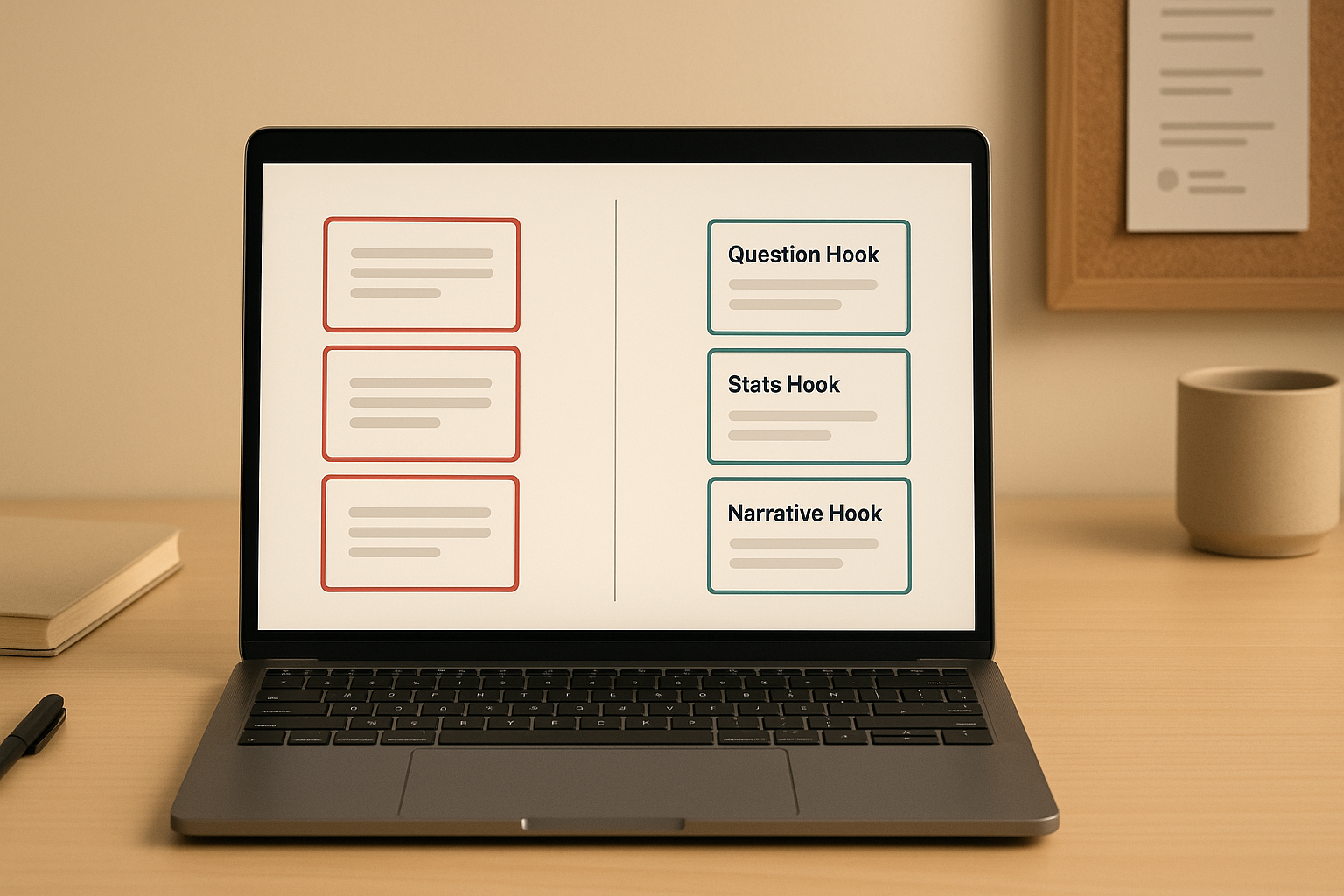
The Wrong Diagnosis Everyone Makes First
When AI output starts looping, the first assumption is that the model is being lazy. So people raise the temperature setting. They add “be creative” to the prompt. They regenerate three times and pick the best one.
None of that solves it.
Temperature controls randomness at the token level. It does not tell the model to explore different structural angles, different opening hooks, or different argument sequences. A high temperature on a static prompt produces chaotic variation, not meaningful variation. You get different words arranged in the same shape.
The real issue is that the prompt has no memory and no constraint system. Every run starts from zero. The model has no way of knowing it already wrote this structure twice this week. It has no instruction to avoid what it just produced. So it defaults to the safest, most statistically likely output for that prompt — which happens to look a lot like the last one.
Repeatability is not a model limitation. It’s a missing design element in the prompt.
Decision Snapshot
Best for: Content workflows running 5+ posts from the same prompt set
Avoid if: You’re still rewriting the core prompt every week — stabilize the structure first
Reality: Adding variation logic takes more upfront setup than it looks — the payoff is downstream
Verdict: Repeatability is a prompt architecture problem. The model is doing exactly what it was told.
What a Stochastic Loop Actually Looks Like
Here’s the pattern. A content workflow runs the same core prompt repeatedly across different topics. The first output is solid. The second is similar but acceptable. By the fifth or sixth run, the structure has calcified. Same hook style. Same body flow. Same closing move.
The topics are different. The sentences are technically unique. But the posts are functionally identical in rhythm and construction — and a reader who lands on two of them back to back will feel it immediately, even if they can’t name it.
This is the stochastic loop: a prompt that produces statistically similar outputs because it has no signal telling it to deviate from its own prior outputs.
The model isn’t stuck. It’s just doing what it was designed to do — produce the most probable output for the given input. When the input never changes, the output converges.
The Fix Is Not Cosmetic
The tempting fix is to rephrase the prompt slightly each time. Change a word here, add an adjective there. This is cosmetic rewriting and it does not work. The underlying structure remains the same because the structural instructions remain the same.
The actual fix operates at two levels.
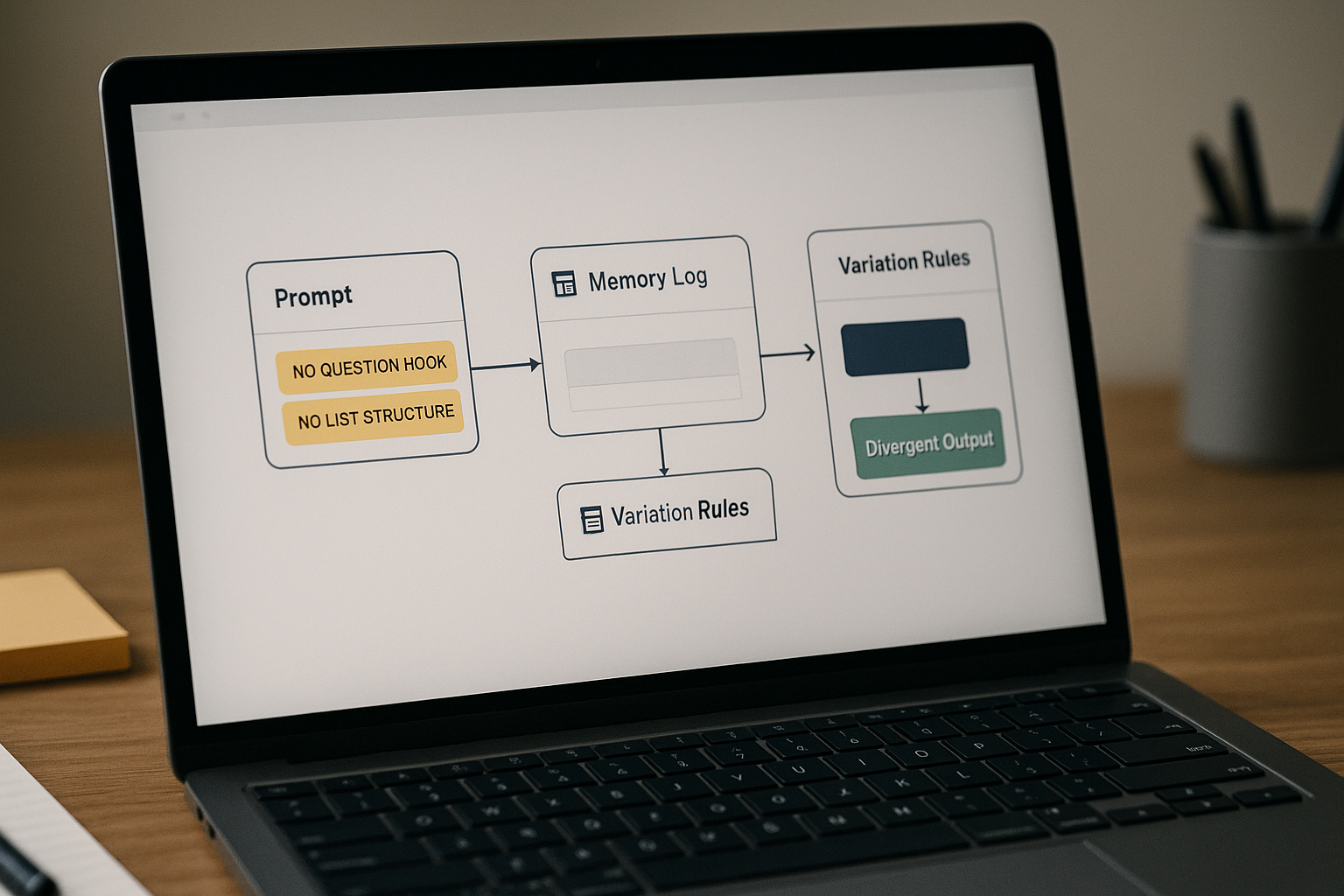
First: Variation Rules. These are explicit constraints added to the prompt that define what the current run must not do. Not vague encouragement to “be creative” — specific structural prohibitions based on what was already produced.
Examples of real variation rules:
- Do not open with a question
- Do not use a list as the first body element
- Do not use a “what it is / why it matters / how to do it” structure
- The hook must create tension through contradiction, not through a statistic
These rules are not permanent. They rotate. What’s forbidden in run six may be permitted in run nine. The goal is structural diversity across the content set, not permanent restriction.
Second: A Memory Node. Something — a spreadsheet, a log file, a node in the automation — tracks what structural patterns have already been used. Before each run, that record gets injected into the prompt as context. The model now has signal it was missing before: this is what already exists, don’t repeat it.
Together, these two additions break the loop. Not because the model changed. Because the prompt finally gave it the information it needed to behave differently.
Before and After: The Same Brief, Two Different Prompt Architectures
Before — Static Prompt (No Variation Logic)
Write a 600-word blog post about [topic]. Make it engaging and informative. Use a strong hook. Include practical tips. End with a clear takeaway.
Output pattern after six runs: Question hook → three H2 sections → numbered list in section two → “here’s what to remember” closing. Every time.
After — Prompt With Variation Rules and Memory Injection
Write a 600-word blog post about [topic].
Variation Rules for this run:
— Do not open with a question
— Do not use a numbered list in the body
— Structure must not follow a “what / why / how” sequenceMemory — structures already used in this content set:
— Run 1: Contradiction hook, two H2s, anecdote-led body
— Run 2: Statistic hook, three H2s, list-heavy body
— Run 3: Failure scenario hook, Q&A structureThis run must use a different hook type and a different body structure from all prior runs listed above.
The output diverges structurally because the input finally contains structural direction. The model isn’t guessing anymore. It has a constraint set and a record of what to avoid.
The Hook and Section Rotation System
Running this manually is fine for small content sets. At scale, it needs a rotation layer.
The practical approach: maintain a closed list of hook types and section structures. Something like five to seven hook patterns and four to five section architectures. Each run pulls from the list and marks the used option. When the list cycles through, it resets — but not before a minimum spacing rule prevents the same pattern from appearing in consecutive posts.
Technically, this can live in a simple tracking document that gets read before each workflow run. One node reads the log. One node injects the constraints. The prompt generation node receives both the topic and the variation context. The output is structurally unique by design, not by accident.
This is not complicated. But it does require treating content variation as a system requirement, not a nice-to-have.
Content Variation Workflow — With and Without Rotation Logic
Without Variation System
With Rotation + Memory
Static brief, no structural constraints
Brief + variation rules + memory log injected
Structurally identical to runs 3 and 4
Divergent hook, different section architecture
Manual editor rewrites structure each time
Editor reviews tone and accuracy, not structure
Repetition compounds — reader trust erodes quietly
Structural diversity maintained without manual intervention
The Profit Angle
You don’t have a repetitive AI problem. You have an editor silently restructuring every post before it goes live — and that labor is invisible, untracked, and compounding every time the content volume grows.
Where This Approach Breaks
This system works well once the base prompt is stable. If the core prompt is still being rewritten every week, the variation layer adds confusion rather than clarity. The memory log becomes unreliable if the structural rules keep changing underneath it.
It also doesn’t solve semantic repetition. If the same arguments, examples, and conclusions appear across posts — just in different structural arrangements — the reader still experiences repetition. Variation rules govern form, not substance. The research layer, the angle selection, the core argument — those still need human direction or a separate content differentiation process upstream.
And at very high volume, the closed list of hook and section patterns will eventually feel exhausted, even with rotation spacing. The list needs periodic expansion. That’s a maintenance task, not a one-time setup.
None of this makes the system not worth building. It just means the system has a scope, and that scope is structural variation, not full content uniqueness.
The Scenario That Makes the Cost Visible
A content workflow producing twelve posts a month from a shared prompt template. The first month, the output is strong. By month three, an editor is quietly restructuring the opening and swapping section order on roughly half the posts before they go live.
Nobody flagged it as a system failure. It just became part of the editing step. The correction loop was invisible — until the editor left and the posts went out unedited and the reader feedback arrived.
The fix wasn’t a better model. It wasn’t a different tool. It was adding a variation rules block and a running log of structural patterns already used. Two additions to the existing prompt. The editor’s restructuring workload dropped significantly on the next cycle.
The workflow that was assumed to be automated was partially manual all along. The automation had been quietly delegating its structural failure to a human, and no dashboard was measuring it.
— — —
If the pattern above sounds familiar, the setup notes for a basic variation system — including a hook rotation template and memory log structure — are available to subscribers. No upsell. Just the working version.
The Edge — Workflow Notes
Get the hook rotation template and memory log structure used in this breakdown.
Join the list → get the setup notes on the next send.
Before You Go
The model didn’t get lazy — the prompt never told it that it had already been here before. Every system that produces without memory eventually produces the same thing twice, then three times, then until someone notices. Variation is not a creative choice. It’s a structural input the prompt was always missing.