
It sat on page four and never moved.
Not because it was thin. Not because the domain was weak. The content matched the keyword — or at least, it looked like it did. That’s the part nobody warns you about: the gap between matching a keyword and matching the reason someone searched for it. Those are two different things, and AI almost always gets the first one right while completely missing the second.
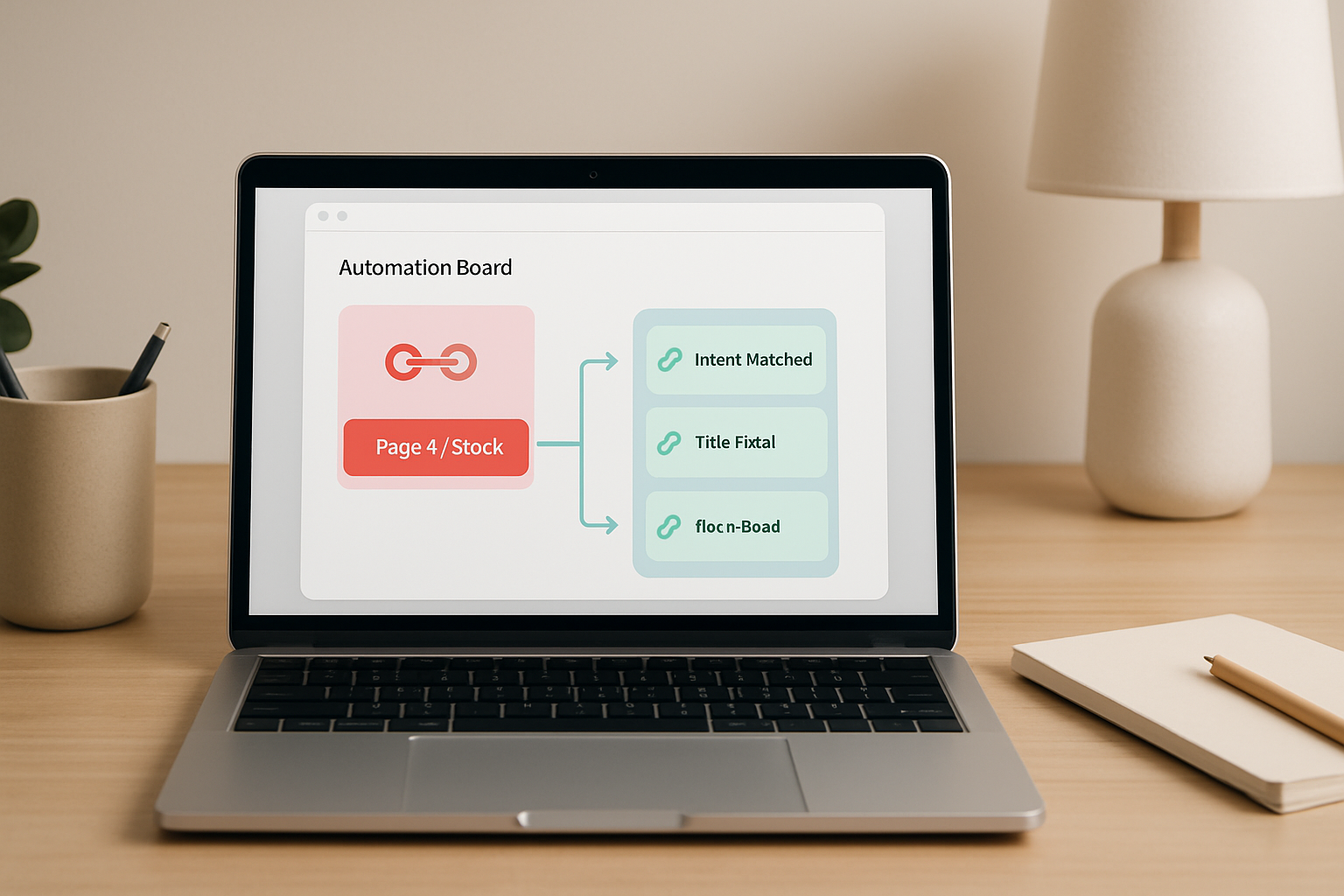
The SEO Intent ROI Audit
- Page 4 Purgatory: If your post is indexed but stuck on page 4, you don’t have a quality problem—you have a “Solution Mismatch” that no amount of polish can fix.
- Keyword Blindness: AI is a world-class keyword parrot but a third-class mind reader. It writes for the search engine, while Google ranks for the searcher.
- Commercial Suicide: Writing “What is…” content for a “Best of…” keyword is the fastest way to waste your API budget and kill your conversion rate.
- The 5-Minute ROI: Why a five-minute intent check before prompting saves twelve hours of structural rewriting later.
Decision Snapshot
Best for: Publishers using AI to scale content who are seeing indexing without ranking
Avoid if: Your site has under 20 indexed pages — authority gaps will dominate over intent problems
Reality: Fixing intent mismatch takes a structural rewrite, not a quick metadata edit
Verdict: Intent alignment is the one fix that actually moves positions — everything else is maintenance
The Assumption That Breaks Everything
Most people publishing AI content assume the ranking problem is a quality problem. So they add more words. They improve the outline. They run it through a readability checker. They tweak the meta description.
None of that fixes the real issue.
The real issue is this: AI generates content shaped around a keyword. Google ranks content shaped around a search intent. Those two things overlap sometimes. But when they don’t, no amount of polish saves the post.
A keyword like “best project management software for agencies” looks informational on the surface. Someone could write a thorough overview of what project management software is, how it works, which categories exist. The AI will do exactly that if you let it. It will produce something accurate, organized, and completely wrong for the query.
That keyword is commercial. The person searching it is about to make a buying decision. They want comparison, differentiation, pricing context, and a clear recommendation. An informational overview — no matter how well-written — does not answer that question. Google knows it doesn’t. The post stays on page four.
What “Informational” AI Content Actually Looks Like
Here’s the pattern that appears over and over. A post targets a commercial or transactional keyword. The AI generates content that explains the topic. The structure is clean. The headings are logical. The word count is respectable.
But read the first five paragraphs and ask: does this content help someone make a decision? Or does it help someone understand a concept?
Those are different documents. Google’s ranking systems have become remarkably good at separating them.
The failure isn’t subtle. When AI is given a keyword and asked to write a post, it defaults to explanation mode. It defines terms. It provides context. It lists features neutrally. This is the shape of informational content — and it’s the wrong shape for any keyword where the searcher’s next action is a click, a purchase, a signup, or a comparison.
The Profit Angle
You don’t have a content volume problem. You have someone producing posts that will never rank, and the only person who knows that is Google.
The Mistake → Correction Pattern
Posts indexed but stuck on page four. The first assumption was competition — the keyword was too hard, the domain didn’t have enough authority. So the response was to produce more content, target lower-difficulty variations, build more internal links.
Positions didn’t change.
The actual cause was simpler and harder to accept: the content was purely informational for a keyword with clear commercial intent. Google was not ignoring the post because of domain weakness. It was ignoring it because the post did not answer the question the searcher was actually asking.
The fix was structural, not cosmetic. The post was rebuilt to match commercial intent — direct comparisons, clear recommendations, original positioning, and a reason to choose one option over another. Positions moved. Not overnight, but they moved.
The pattern here is worth naming: Google ranks solutions, not word counts. A 600-word post that directly answers a commercial query will outrank a 2,400-word post that explains the surrounding topic without ever committing to a recommendation.
Before / After: Same Keyword, Wrong vs. Right Intent Frame
The keyword: “email automation tools for small business”
Before (AI default — informational frame):
“Email automation refers to the process of sending triggered or scheduled emails to subscribers based on predefined rules. Small businesses use these tools to save time and improve customer communication. In this article, we will cover what email automation is, how it works, and the main categories of tools available.”
This is a definition. It is not a buying guide. The person searching that keyword already knows what email automation is. They want to know which tool to use and why.
After (intent-matched — commercial frame):
“If you’re running a small business and you’ve outgrown manual follow-ups, the real question isn’t whether to automate — it’s which tool won’t cost you three hours of setup for a five-email sequence. Here’s what actually separates the tools that work for lean teams from the ones built for enterprise teams with a dedicated ops person.”
Same keyword. Completely different intent frame. The second version signals to Google — and to the reader — that this post will help them make a decision. That signal is what moves rankings.
How to Diagnose Intent Before You Write
The fix starts before the prompt, not after.
For any keyword, run this three-question check before generating content:
- What is the searcher’s next action? Are they trying to learn something, compare options, or make a purchase? This determines informational, commercial, or transactional intent.
- What does page one actually look like? Search the keyword. If the top results are comparison articles, listicles with clear recommendations, and pricing breakdowns — the intent is commercial. If they’re definitions and explainers — it’s informational. Match the format, not just the topic.
- Does your post answer the implicit question? The implicit question is always one level deeper than the keyword. “Email automation tools” implicitly means “which one should I use and why.” If your post doesn’t answer that, it won’t rank for that keyword.
This check takes roughly five minutes. Skipping it is what produces posts that look correct and never move.
The Title Problem Nobody Talks About
AI-generated titles compound the intent problem. A model asked to title a post about “best CRM for freelancers” will often produce something like:
“Understanding CRM Systems: A Complete Guide for Freelancers”
That title signals informational content to both Google and the reader. It will attract informational-intent clicks — people who want to understand CRM, not people ready to choose one. The result is low engagement from the wrong audience, which further signals to Google that the content doesn’t satisfy the query.
The corrected title signals intent directly:
“The 5 Best CRMs for Freelancers in 2026 (Ranked by Setup Time and Price)”
This tells Google what the post does. It tells the searcher what they will get. It attracts clicks from people whose intent matches the content. That alignment is what the ranking system rewards.
Title correction formula for commercial keywords: Lead with a superlative or ranking signal → include the keyword → add a differentiator that matches the searcher’s real concern (price, time, complexity, use case).
Where This Fix Breaks Down
Intent alignment is not a universal solution. There are real cases where it doesn’t move the needle, and being honest about those matters.
When the domain has no topical authority: If the site has published ten posts and is targeting competitive commercial keywords, intent alignment will not overcome authority gaps. The fix is necessary but not sufficient.
When the SERP is dominated by aggregators: Some commercial keywords are entirely owned by review platforms, marketplaces, or media brands with massive link profiles. Matching intent perfectly still won’t crack page one for those queries. The smarter play is to find adjacent long-tail variants where the intent match gives a genuine edge.
When the content lacks original data or positioning: Restructuring for commercial intent is the first step. But if ten other sites have done the same thing with better original research, pricing data, or user-generated evidence, intent alignment alone won’t win. The post needs something the AI cannot generate: a genuine point of view, original data, or experience-based differentiation.
The pattern holds: intent mismatch is almost always part of the problem when AI posts don’t rank. It is rarely the only part.
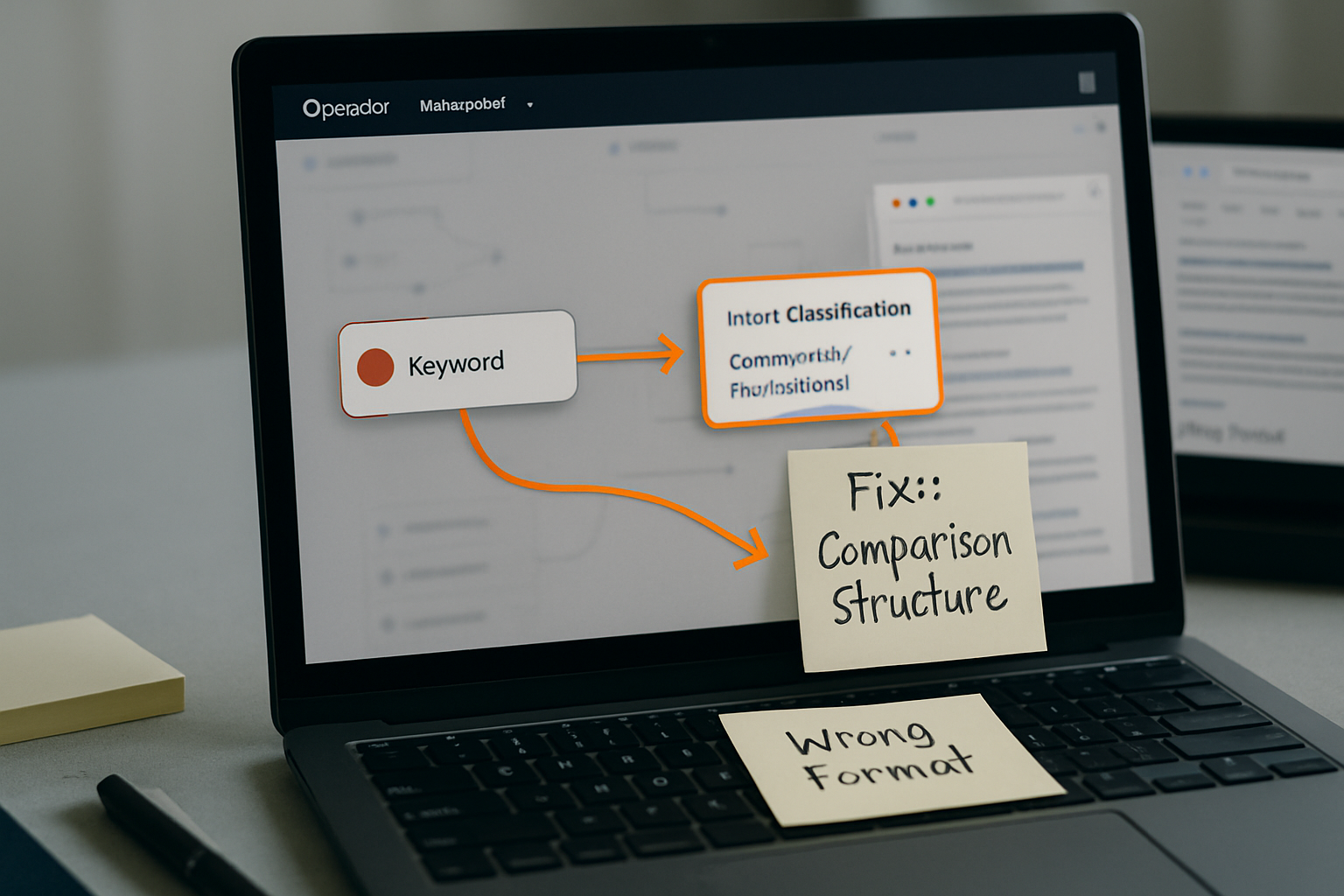
The Diagnostic Workflow
For posts already published and stuck, this is the sequence that addresses the actual problem:
- Check current ranking position. If the post is indexed but sitting on pages three through six, intent mismatch is the first thing to investigate — not domain authority.
- Search the target keyword and audit page one. Note the content format of the top five results. Are they guides, comparisons, listicles, or definitions? If your post format doesn’t match, that’s the problem.
- Identify the implicit question. Rewrite the opening paragraph to answer that question directly rather than defining the topic.
- Fix the title. Apply the correction formula: ranking signal + keyword + searcher-specific differentiator.
- Restructure the body. For commercial intent posts, the structure should be: direct recommendation → evidence → comparison → objection handling → clear conclusion. Not: definition → history → categories → neutral summary.
- Add original data or positioning. One stat, one original comparison, one genuine recommendation that isn’t available in the AI’s training data. This is what separates a restructured post from a still-generic post.
- Update and re-submit to Google Search Console. After structural changes, request re-indexing via Google Search Console → URL Inspection → Request Indexing.
Rough Time Comparison
AI default draft (no intent check): roughly 8 minutes to generate, weeks of zero movement
Intent-checked draft (5-min diagnostic + structural prompt): roughly 20 minutes total, post enters competitive range within typical crawl cycle
The extra 12 minutes up front removes the need to rewrite the post later. That’s the actual ROI.
Get the Intent-Fix Prompt Pack
The exact prompt structure for diagnosing intent mismatch before you write — plus the rewrite framework for posts already stuck on page four.
Worth Knowing
Google does not reward content that covers a topic. It rewards content that resolves a search. The gap between those two things is where most AI posts quietly disappear.