
The first instinct is always the model. Context window. Token limit. Something upstream got truncated. That assumption costs time, because it is almost never the model. The data disappeared somewhere between agents, and the model never had a chance.
The Workflow Efficiency Audit
- Stop the Hidden Labor: If a human is manually patching “automated” outputs, you aren’t automating—you’re just delaying the work.
- The Handoff Gap: Why 90% of pipeline failures are caused by a single missing JSON field, not “bad AI.”
- Stop Wasting Tokens: Why upgrading to a more expensive model (like GPT-4o) won’t fix a broken data handoff.
- The Scalability Fix: How a simple “Global State Object” cuts human review time from 40 minutes to 3 minutes per run.
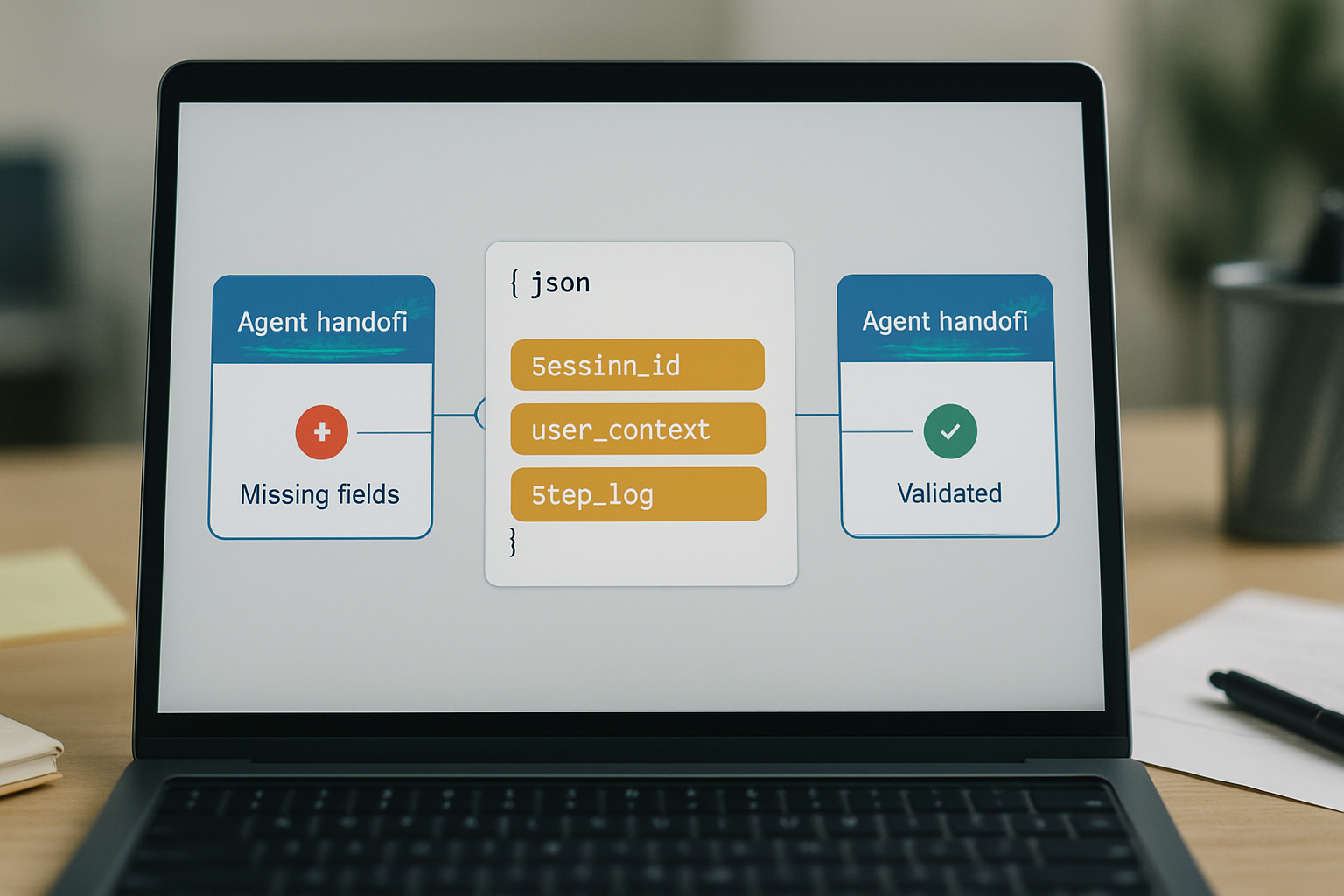
Where the Data Actually Goes Missing
In a single-agent workflow, state is easy. One agent holds everything. The problem only appears when you split responsibility — when Agent 1 handles extraction, Agent 2 handles enrichment, and Agent 3 handles output generation.
Each handoff is a gap. And most frameworks do not close that gap by default.
Here is the failure pattern: Agent 2 completes its task and passes a result object to Agent 3. But that result object does not carry the session context Agent 1 established. Agent 3 has no idea which session it is operating in. It produces nothing, or worse, it produces something plausible but wrong.
The symptom looks like a model failure. The actual cause is a missing field in the handoff object. Specifically: session_id was never passed from Agent 2 to Agent 3. Agent 3 cannot anchor its output to any prior context. The pipeline breaks at step 3 — not because of memory limits, but because one identifier was dropped.
This is not a rare edge case. It is the default behavior when agents are built in isolation and wired together afterward.
Verify your handoff payload: open your workflow logs, find the object passed between Agent 2 and Agent 3, and check whether session_id, user_context, and any persistent reference fields are present. If they are absent, you found the gap.
The Wrong Diagnosis and Why It Sticks
The assumption was that the model had hit a memory ceiling. Reasonable guess. The pipeline was processing a moderately long document, and the output collapsed at exactly the point where context accumulation was heaviest.
It wasn’t the memory ceiling. Every agent had sufficient context window available. The issue was upstream: a missing identifier that the receiving agent required to reconstruct session state.
This wrong diagnosis is sticky because it is directionally plausible. Developers spend time adjusting chunk sizes, reducing prompt length, and compressing summaries — none of which fix a missing field in the handoff object. The pipeline continues to fail. The debugging loop runs longer than it should.
The correction only came from inspecting the raw payload between agents, not the agent outputs themselves. That is the right debugging layer for this class of failure.
What a Broken Handoff Looks Like vs. a Structured One
This is the before state. Agent 2 passes a minimal result object:
{
  "enriched_data": {
    "company": "Acme Corp",
    "industry": "SaaS",
    "score": 82
  }
}
Agent 3 receives this. It has enriched data but no session anchor, no originating user context, no task metadata. If Agent 3 needs to reference prior extraction steps, cross-check a field against the original intake, or route the result to the correct output destination — it cannot. The session context was dropped at the Agent 1 → Agent 2 boundary and never recovered.
After the fix, the handoff object carries a global state wrapper:
{
  "session_id": "sess_20260512_0041",
  "user_context": {
    "user_id": "usr_9921",
    "pipeline_run": "run_00143",
    "originating_task": "lead_qualification"
  },
  "agent_metadata": {
    "source_agent": "agent_enrichment",
    "handoff_timestamp": "2026-05-12T09:14:32Z",
    "step_index": 2
  },
  "payload": {
    "enriched_data": {
      "company": "Acme Corp",
      "industry": "SaaS",
      "score": 82
    }
  }
}
Agent 3 now has everything it needs: the session anchor, the originating task type, the step position in the pipeline, and the enriched payload. It can generate output, route results correctly, and log against the right session. The pipeline completes.
The fix is not architectural. It is one additional wrapper object defined at the start of the pipeline and carried through every agent boundary.
Defining the Global State Object
The practical correction is a global state schema defined before any agent runs. Every agent receives this object, reads what it needs, appends its own output, and passes the full object forward.
Here is a minimal working schema:
{
  "session_id": "string — unique per pipeline run",
  "pipeline_version": "string — for debugging across deploys",
  "user_context": {
    "user_id": "string",
    "source": "string — intake form / API / webhook",
    "originating_task": "string"
  },
  "step_log": [
    {
      "agent": "string",
      "step_index": "integer",
      "status": "passed | failed | skipped",
      "timestamp": "ISO 8601"
    }
  ],
  "payload": "object — agent-specific data, grows with each step"
}
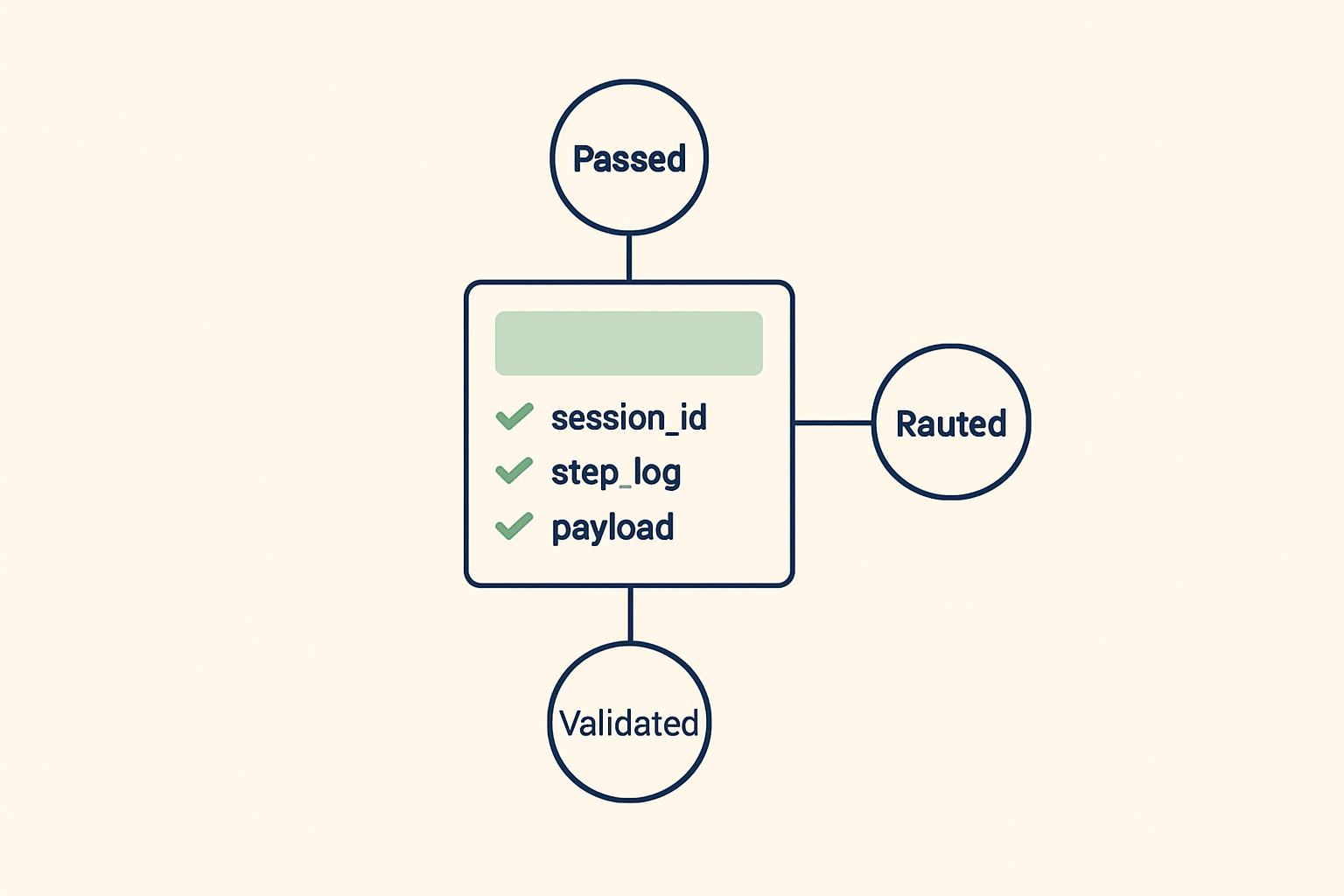
Each agent appends to step_log before passing the object forward. If an agent fails, the log captures the failure state, the step index, and the timestamp. The next agent in the chain can inspect the log and decide whether to proceed, retry, or route to a review queue.
State management is not optional scaffolding. It is the backbone of any multi-agent pipeline that needs to survive beyond a demo.
Implementation path: define this schema in a shared config file or central state module → import it at the top of each agent’s execution function → validate the incoming object against the schema before the agent runs → append output and pass forward.
The Operational Cost of Skipping This
The Profit Angle: The pipeline looks automated. Somewhere downstream, a person is quietly re-running failed jobs, checking which agent dropped the context, and manually patching the output. That correction loop is invisible in your workflow metrics and very visible in your labor hours.
Without a structured handoff object, the failure mode is not a crash — it is silent degradation. Agent 3 returns a result that is technically formatted but contextually wrong. A human catches it during review, corrects it, and moves on. This happens again on the next run. And the next.
For a 10-client workload, that correction loop runs roughly 20 to 40 minutes per failed pipeline run depending on how deeply the output needs to be reconstructed. After the global state object is in place, that loop disappears. Agent failures become visible in the step log, routable to a review queue, and traceable to the exact step where the handoff broke.
Correction loop: before vs. after
Before structured handoff: roughly 20–40 min of manual correction per failed run, no visibility into which agent dropped context, output errors caught only during human review.
After global state object: failed runs route automatically to review queue with step_log attached, failure step visible immediately, correction time drops to roughly 3–5 min triage per incident.
Where This Breaks
The global state object solves the data gap problem. It does not solve everything.
If agents run in parallel rather than sequentially, the state object needs a merge strategy. Two agents writing to the same payload simultaneously will overwrite each other’s output unless you implement a merge layer or lock the payload during writes.
If the pipeline spans multiple external APIs, the session_id may not be sufficient as a routing anchor. Some APIs generate their own session tokens. You will need a mapping layer between your internal session_id and the external API’s reference identifier.
If the agent framework you are using strips custom metadata from handoff objects — some do, particularly when using built-in handoff mechanisms that only pass message history — the wrapper approach requires a workaround: store state externally in a key-value store and pass only the session_id in the handoff, letting each agent retrieve the full state from the store at runtime.
The structured handoff object is a pattern, not a framework feature. It requires active maintenance when the pipeline changes. If a new agent is added and the developer does not include the state schema in the new agent’s input contract, the gap reopens.
Implementation Checklist
Before the pipeline runs in production, verify each of these:
- Global state schema is defined in a shared module, not duplicated per agent.
- Every agent validates the incoming state object against the schema before executing.
session_id,user_id, andoriginating_taskare present in every handoff object — verify in raw logs, not just agent output.step_logis appended by each agent before passing forward — status must bepassed,failed, orskipped, never empty.- Failed steps route to a review queue with the full
step_logattached, not just a generic error message. - If any agent uses an external API, a session mapping layer exists between internal
session_idand external reference tokens. - New agents added to the pipeline are reviewed against the state schema contract before deployment.
Get the workflow breakdown
If you are building multi-agent pipelines and want the full state schema template plus failure routing logic, join the list. The next breakdown covers how to handle agent failures gracefully without restarting the full pipeline from scratch.