
Prompt Engineering Tools for Data Analysis: Features, Pricing & Comparison (2025)
To save readers extensive research time, this article compiles verified data from official sources and trusted review platforms as of November 25, 2025.
Introduction to Prompt Engineering Tools for Data Analysis
Prompt engineering has become a critical skill for extracting valuable insights from modern AI models. These tools help data analysts and business intelligence professionals craft effective prompts that deliver accurate and relevant analytical results.
The Role of Prompt Engineering in Data Analysis
Prompt engineering involves designing precise prompts to elicit desired responses from AI systems in data-driven tasks.
When applied to data analysis, effective prompt engineering can:
- Transform raw data into actionable insights with minimal manual effort
- Standardize analytical processes across teams and workflows
- Reduce technical barriers for performing complex data operations
- Improve consistency and reproducibility of analytical outcomes
Key Features to Look for in Prompt Engineering Tools
When assessing prompt engineering tools for data analysis, several capabilities stand out:
- Prompt templates for common analytical tasks
- Version control to track changes in prompt development
- Collaboration tools for team-based workflows
- Platform integrations with data analysis ecosystems
These features form the core of effective prompt engineering tools used in contemporary data workflows.
Top Prompt Engineering Tools for Data Analysis
Tool 1: ChatGPT Plus
Features and Capabilities
ChatGPT Plus offers enhanced performance and capabilities suited for data analysis:
- Advanced prompt templates for statistical and exploratory analysis
- Access to advanced models with strong reasoning capabilities
- Higher rate limits for larger analytical workloads
- Priority access to new features and improvements
- Custom instructions that remain consistent across sessions
Use Cases for Data Analysis
ChatGPT Plus supports multiple data analysis scenarios:
- Exploratory data analysis using natural language queries
- Data cleaning prompt generation for preprocessing
- Interpretation of statistical results
- Automated report generation based on findings
My Take
ChatGPT Plus provides the best price-to-performance ratio for general users. Its consistent reasoning quality and fast response speeds make it the most stable choice for everyday analytical tasks.
Tool 2: Claude by Anthropic
Features and Capabilities
Claude provides several strengths for data-centric prompt engineering:
- Extended context windows enabling long-form data interpretation
- Constitutional AI safeguards helping reduce analytical errors
- Advanced reasoning for complex statistical concepts
- Structured data formatting for tables and datasets
Use Cases for Data Analysis
Claude excels in:
- Multivariate and complex analysis
- Reviewing lengthy research documents
- Generating detailed analytical narratives
- Producing thorough data documentation
My Take
Claude excels in writing, summarization, and deep analytical reasoning. It’s especially good for document-heavy workflows. However, heavy API usage can ramp up costs quickly, so it’s best suited for users who need advanced analysis and can monitor their usage.
Tool 3: Cohere Coral
Features and Capabilities
Cohere Coral delivers enterprise-focused features for data workflows:
- Industry-specific prompt libraries
- Command models optimized for structured data tasks
- Enterprise-level security
- API-first integrations for data pipelines
- Multilingual data support
Use Cases for Data Analysis
Common enterprise uses include:
- Large-scale data transformation
- Automated insight generation from performance metrics
- Cross-language analytics
- Embedding-based clustering and classification
My Take
Cohere’s main strength is scalability. Its transparent token-based pricing makes it ideal for large-volume API workloads, especially in enterprise environments. For individual or small-scale users, the benefits may feel less substantial compared to ChatGPT or Claude.
Pricing and Subscription Models
ChatGPT Plus Pricing
ChatGPT Plus is available through a monthly subscription designed for individual users who need enhanced performance and priority access:
$20/month
Includes premium model access and faster response speeds
No additional usage fees for standard use
This plan is ideal for creators, professionals, and researchers who rely on consistent availability and advanced reasoning capabilities.
Claude by Anthropic Pricing
Claude offers flexible options depending on user type and usage volume:
Claude Pro: Approx. $20/month, providing higher rate limits and priority access
Claude Team: Custom enterprise pricing for organizations
API Access: Usage-based billing, priced per token depending on the model tier
Claude’s pricing structure appeals to both individual power users and teams needing scalable AI support.
Cohere Coral Pricing
Cohere Coral provides access to Cohere’s flagship AI models using a transparent usage-based billing system:
Input tokens: Approximately $1.00 per 1M tokens
Output tokens: Approximately $2.00 per 1M tokens
Free tier: Includes a limited number of tokens for initial testing
Enterprise plans: Custom pricing available for large-scale deployments and private model hosting
This token-based structure offers predictable costs while allowing developers to scale usage according to project needs.
Comparison of Prompt Engineering Tools
Comparison Grid: Prompt Engineering Tools for Data Analysis (2025)
| Tool | Best For | Key Strengths | Context & Reasoning | Pricing Model |
|---|---|---|---|---|
| ChatGPT Plus | General-purpose data analysis | Stable reasoning, prompt templates, fast responses | Strong for everyday analytical tasks | $20/month (flat subscription) |
| Claude (Anthropic) | Long-form and research-heavy analysis | Extended context, deep reasoning, document handling | Industry-leading long context windows | ~$20/month (Pro) + usage-based API |
| Cohere Coral | Enterprise-scale data pipelines | API-first design, structured data handling, scalability | Optimized for large-volume processing | Token-based ($1–$2 per 1M tokens) |
Feature Comparison
Several key differences emerge when comparing the three tools:
- Context length: Claude leads with extended windows; ChatGPT and Cohere vary by model
- Integration: Cohere provides deep API support; ChatGPT offers plugins
- Template libraries: All platforms offer specialized prompt templates
- Collaboration features: Strongest in enterprise plans
Pricing Comparison
Cost considerations vary depending on use case:
- Individuals: ChatGPT Plus and Claude Pro provide strong value at $20/month
- Teams: All providers offer enterprise pricing tiers
- API access: Usage-based pricing across OpenAI and Cohere
- Open‑source options: Free but require implementation effort
Ease of Use and Integration
The tools differ in user experience:
- ChatGPT Plus: Most beginner-friendly
- Claude: Balanced usability and advanced features
- Cohere: Best for developers needing deep integration
- Open‑source tools: Most flexible but require technical skill
Practical Insight: Prompt Quality Matters More Than Model Choice for Most Data Tasks
In data analysis workflows, teams often focus on selecting the most advanced model while underestimating the impact of prompt design. In practice, well-structured prompts—clear objectives, explicit assumptions, and defined output formats—often produce more reliable results than switching between similar high-quality models.
For most analysts, consistency in prompt structure improves reproducibility across reports and teams. This is why tools that support prompt versioning, templates, and reuse frequently outperform raw model access in real-world data environments.
Choosing a tool that encourages disciplined prompt design can reduce analytical errors and improve collaboration, regardless of whether the underlying model is optimized for general reasoning or extended context.
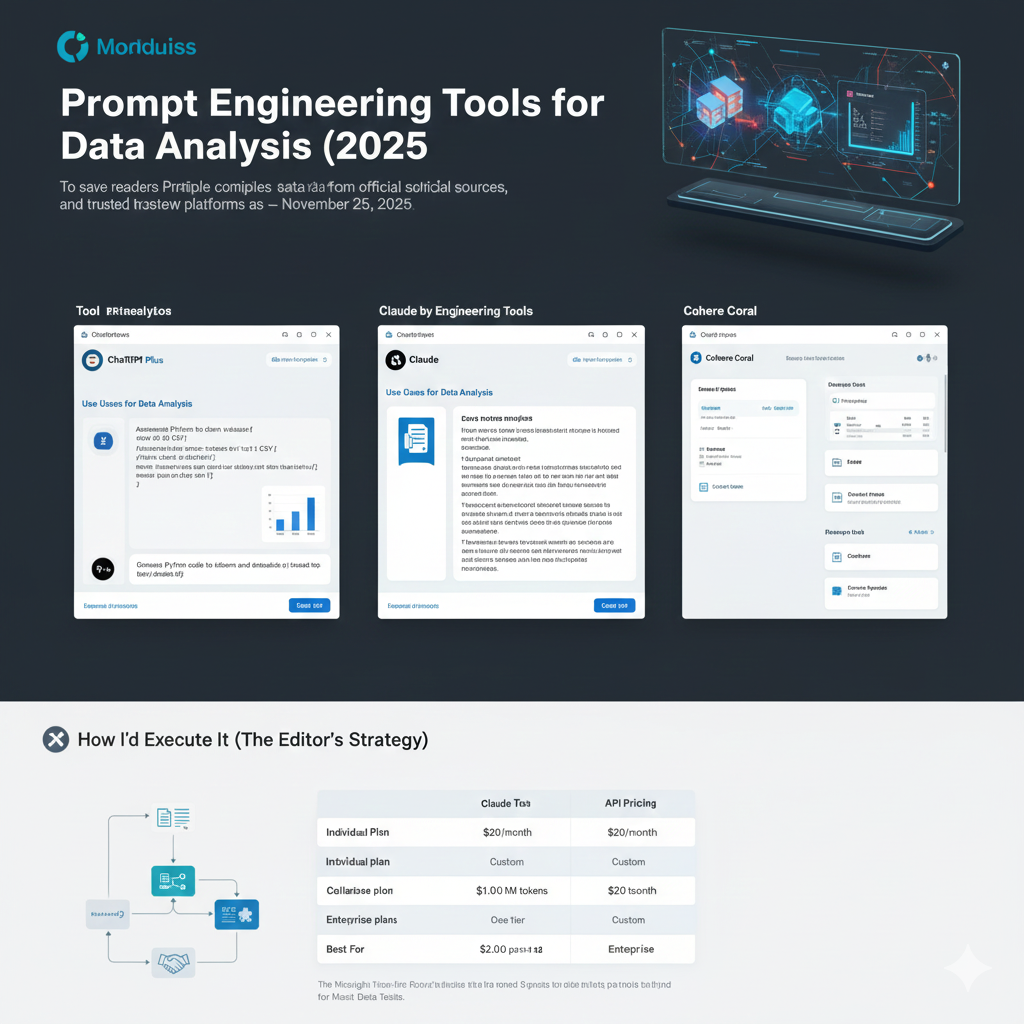
How I’d Execute It: The Editor’s Data Analysis Pipeline
If I were integrating these tools into a professional data analyst workflow, I would avoid relying on a single platform. Instead, I would build a Hybrid Workflow by segmenting the analytical process and assigning each tool to the stage where it provides maximum efficiency.
– Initial Hypothesis & Code Generation (ChatGPT Plus)
- Goal: Setting the analytical direction and preparing for data extraction.
- Strategy: I would leverage ChatGPT Plus‘s general reasoning ability, treating it like a highly capable “Junior Analyst.” I would start by querying it: “Given this dataset, what are the top three actionable insights we should prioritize?” This helps quickly form hypotheses. I would then use it to generate complex SQL queries or Python preprocessing code, significantly accelerating the initial setup time.
– Large-Scale Report Analysis & Contextual Deep Dive (Claude)
- Goal: Interpreting massive volumes of unstructured text data.
- Strategy: When facing hundreds of pages of industry reports or voluminous customer feedback logs, Claude is the go-to. I would utilize its extended context window to ask, “Read this entire document and connect the three key emerging trends to our internal performance metrics.” Its superior writing and summarization capabilities make it excellent for drafting the narrative sections of the final analytical report.
– Internal System Integration & High-Volume Automation (Cohere Coral)
- Goal: Automating repetitive analysis tasks and integrating with internal systems.
- Strategy: For daily, repetitive tasks like data classification, anomaly detection, or handling sensitive internal data, the Cohere Coral API would be implemented. Its transparent, token-based pricing allows for predictable cost scaling when processing large data volumes, and its enterprise-focused features make integration into secure, private cloud environments much easier to advocate for with IT/Security teams.
Pro Tip: View these tools not as competitors, but as team members. Structure your pipeline by assigning ChatGPT as the ‘Coding Assistant,’ Claude as the ‘Research Analyst,’ and Cohere as the ‘Scalable Operations Team.’
Conclusion
Choosing the Right Tool for Your Needs
The ideal prompt engineering tool depends on your goals:
- Individual analysts: ChatGPT Plus offers a strong balance of features and usability
- Enterprise teams: Cohere Coral excels in system‑wide integration
- Research‑intensive work: Claude’s extended context window offers advantages
- Budget‑conscious users: Open‑source tools remain powerful free options
Future Trends in Prompt Engineering for Data Analysis
The field continues to evolve, with trends including:
- Automated prompt optimization to simplify complex analysis
- Industry‑specific analytical models
- Deeper integration with BI platforms
- Shared prompt libraries supporting organizational adoption
As these developments mature, prompt engineering will become an essential part of data analysis workflows.

Editor’s Summary
Prompt engineering tools have become a foundational layer in modern data analysis workflows. ChatGPT Plus offers the most accessible balance of usability, reasoning quality, and predictable pricing for individual analysts. Claude stands out for document-heavy and research-intensive tasks where extended context is essential, while Cohere Coral excels in scalable, API-driven environments that demand predictable costs at high volumes.
The most effective teams focus less on chasing the “best” model and more on standardizing how prompts are designed, shared, and maintained. Tools that support consistency and reuse tend to deliver more reliable analytical outcomes over time.