
The workflow ran. The logs showed a 429 on step three of seven, and everything downstream silently dropped — no retry, no alert, just a missing output field that nobody caught until the next morning.
The first instinct was to add a simple retry loop with a fixed two-second delay. That looked right in testing. Under parallel load, it made things worse — every stalled workflow resumed at the same moment and hit the rate limit again in a synchronized burst, producing a second 429 wave roughly five seconds after the first.
The root cause wasn’t the retry logic itself. It was that the retry logic had no idea which limit had been hit, and it treated every 429 the same way regardless of whether the constraint was requests-per-minute, tokens-per-minute, or daily quota — three separate counters that reset on completely different schedules.
Why the Three Rate Limit Types Matter Before Writing Any Retry Code
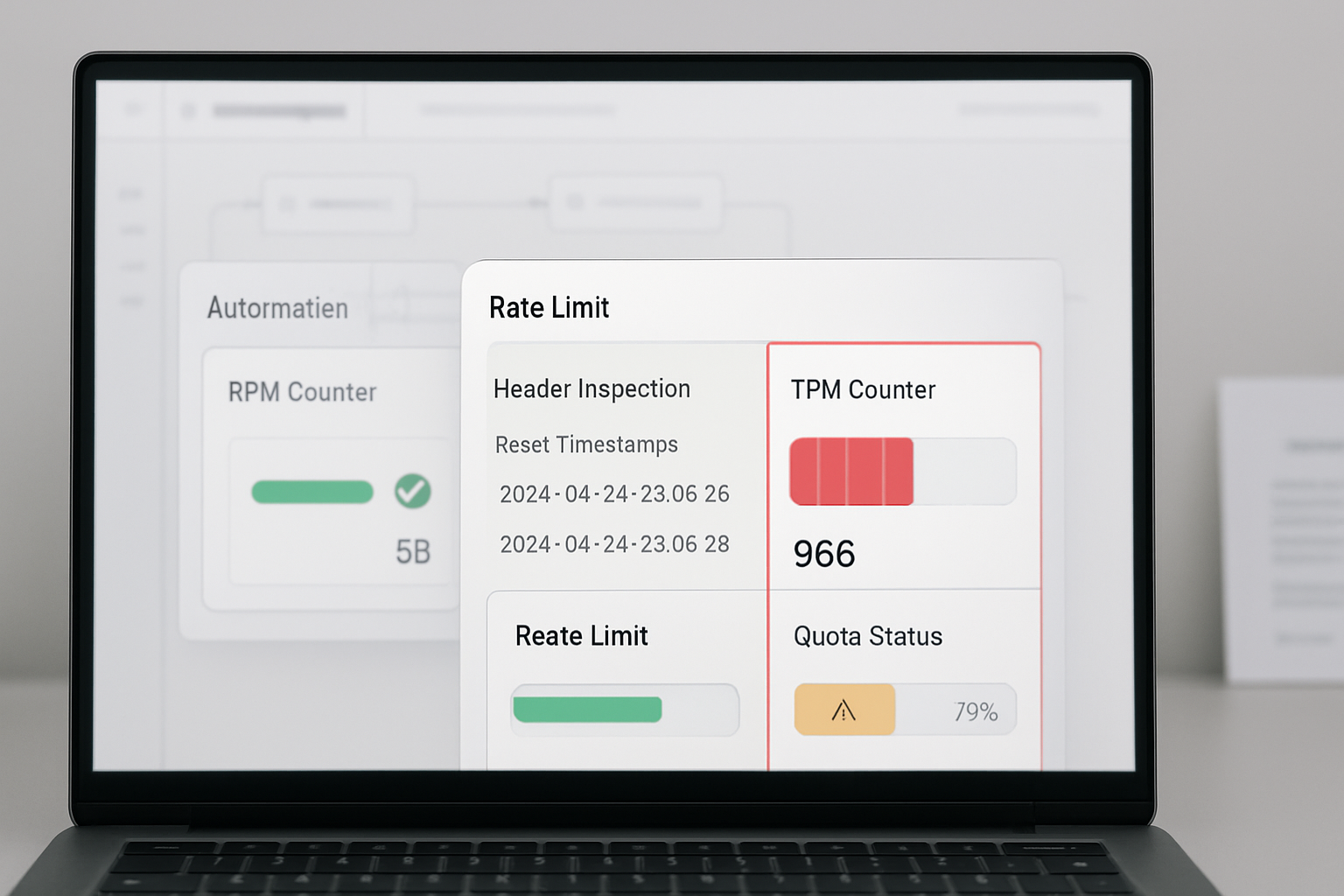
OpenAI enforces at least three distinct rate limit dimensions: RPM (requests per minute), TPM (tokens per minute), and RPD (requests per day). Each one can trigger a 429 independently. A workflow making short, frequent calls is more likely to hit RPM. A workflow processing long documents or chaining large completions hits TPM first, even if the request count looks fine. Daily quota is a hard ceiling that no amount of backoff will fix until the counter resets at midnight UTC.
When a 429 fires, the response headers carry the signal. The key headers to parse are x-ratelimit-limit-requests, x-ratelimit-limit-tokens, x-ratelimit-remaining-requests, x-ratelimit-remaining-tokens, x-ratelimit-reset-requests, and x-ratelimit-reset-tokens. The reset fields return an ISO 8601 duration or a UTC timestamp depending on the endpoint version — check the response format from your tier before assuming the parse logic.
The decision tree for what to do with a 429 is actually short once you have the headers:
- If
x-ratelimit-remaining-requestsis 0 and the reset window is under 60 seconds, wait for the RPM reset and retry. - If
x-ratelimit-remaining-tokensis 0, the delay needs to cover the TPM window — which can be longer than RPM depending on your tier and the size of the preceding calls. - If neither remaining field is zero and you still get a 429, the error is likely a daily quota exhaustion or a server-side overload (529). Daily quota does not retry — it fails fast and surfaces an alert.
- If the response body contains
"type": "insufficient_quota", stop retrying immediately. No backoff strategy recovers from a depleted billing quota.
That last point is where a surprising number of production workflows bleed quietly — retrying a quota error dozens of times before the workflow finally gives up, burning time and generating noise in the logs without any chance of success.
Exponential Backoff With Jitter: The Working Implementation
Linear backoff fails under parallel load because multiple workflows that hit the same rate limit window will also recover at the same time. The fix is to add random jitter to each retry delay so the resume times spread across a window rather than stacking on a single second.
The implementation below handles header parsing, distinguishes RPM from TPM limits, applies full jitter, and fails fast on quota exhaustion. It is written in Python but the pattern ports directly to TypeScript or any language with async HTTP support.
import httpx
import asyncio
import random
import time
from datetime import datetime, timezone

OPENAI_API_URL = "https://api.openai.com/v1/chat/completions"
MAX_RETRIES = 6
BASE_DELAY = 1.0      # seconds
MAX_DELAY = 64.0      # seconds cap

def parse_reset_seconds(reset_header: str) -> float:
    """Parse OpenAI reset header — handles both duration strings and timestamps."""
    if not reset_header:
        return BASE_DELAY
    # Duration format: "1m30s", "45s", "2m"
    if reset_header.endswith("s") or "m" in reset_header:
        total = 0.0
        if "m" in reset_header:
            parts = reset_header.split("m")
            total += float(parts[0]) * 60
            remaining = parts[1].replace("s", "").strip()
            total += float(remaining) if remaining else 0
        else:
            total = float(reset_header.replace("s", ""))
        return total
    # Fallback: treat as Unix timestamp
    try:
        reset_ts = float(reset_header)
        return max(0.0, reset_ts - time.time())
    except ValueError:
        return BASE_DELAY

def classify_429(response: httpx.Response) -> str:
    """Return 'rpm', 'tpm', 'quota', or 'unknown'."""
    body = response.json() if response.headers.get("content-type", "").startswith("application/json") else {}
    error_type = body.get("error", {}).get("type", "")
    if error_type == "insufficient_quota":
        return "quota"
    remaining_req = response.headers.get("x-ratelimit-remaining-requests")
    remaining_tok = response.headers.get("x-ratelimit-remaining-tokens")
    if remaining_req is not None and int(remaining_req) == 0:
        return "rpm"
    if remaining_tok is not None and int(remaining_tok) == 0:
        return "tpm"
    return "unknown"

def jitter_delay(attempt: int, base: float = BASE_DELAY, cap: float = MAX_DELAY) -> float:
    """Full jitter: random value between 0 and min(cap, base * 2^attempt)."""
    ceiling = min(cap, base * (2 ** attempt))
    return random.uniform(0, ceiling)

async def call_openai_with_retry(
    client: httpx.AsyncClient,
    payload: dict,
    headers: dict,
    workflow_id: str = "default"
) -> dict:
    last_error = None
    for attempt in range(MAX_RETRIES):
        try:
            response = await client.post(
                OPENAI_API_URL,
                json=payload,
                headers=headers,
                timeout=30.0
            )
            if response.status_code == 200:
                return response.json()

            if response.status_code == 429:
                limit_type = classify_429(response)

                if limit_type == "quota":
                    raise RuntimeError(
                        f"[{workflow_id}] Daily quota exhausted. "
                        f"Retry will not recover. Failing fast."
                    )

                if limit_type == "rpm":
                    reset_seconds = parse_reset_seconds(
                        response.headers.get("x-ratelimit-reset-requests", "")
                    )
                    delay = reset_seconds + jitter_delay(attempt)
                    print(f"[{workflow_id}] RPM limit hit. Waiting {delay:.1f}s (attempt {attempt+1})")

                elif limit_type == "tpm":
                    reset_seconds = parse_reset_seconds(
                        response.headers.get("x-ratelimit-reset-tokens", "")
                    )
                    delay = reset_seconds + jitter_delay(attempt)
                    print(f"[{workflow_id}] TPM limit hit. Waiting {delay:.1f}s (attempt {attempt+1})")

                else:
                    delay = jitter_delay(attempt, base=BASE_DELAY)
                    print(f"[{workflow_id}] 429 unknown type. Backoff {delay:.1f}s (attempt {attempt+1})")

                await asyncio.sleep(delay)
                last_error = f"429 {limit_type}"
                continue

            if response.status_code in (500, 502, 503, 529):
                delay = jitter_delay(attempt, base=BASE_DELAY * 2)
                print(f"[{workflow_id}] Server error {response.status_code}. Backoff {delay:.1f}s")
                await asyncio.sleep(delay)
                last_error = f"server_{response.status_code}"
                continue

            # Non-retryable client errors (400, 401, 403, 404)
            response.raise_for_status()

        except httpx.TimeoutException:
            delay = jitter_delay(attempt, base=BASE_DELAY)
            print(f"[{workflow_id}] Timeout on attempt {attempt+1}. Backoff {delay:.1f}s")
            await asyncio.sleep(delay)
            last_error = "timeout"

    raise RuntimeError(
        f"[{workflow_id}] All {MAX_RETRIES} retry attempts exhausted. Last error: {last_error}"
    )
The classify_429 function is the piece that most implementations skip. Without it, every 429 gets the same flat delay, which means a TPM exhaustion on a high-token workflow gets the same two-second wait as an RPM blip — and a quota error gets retried six times before anything notices it will never succeed.
The Thundering Herd Problem and Queue-Based Staggering
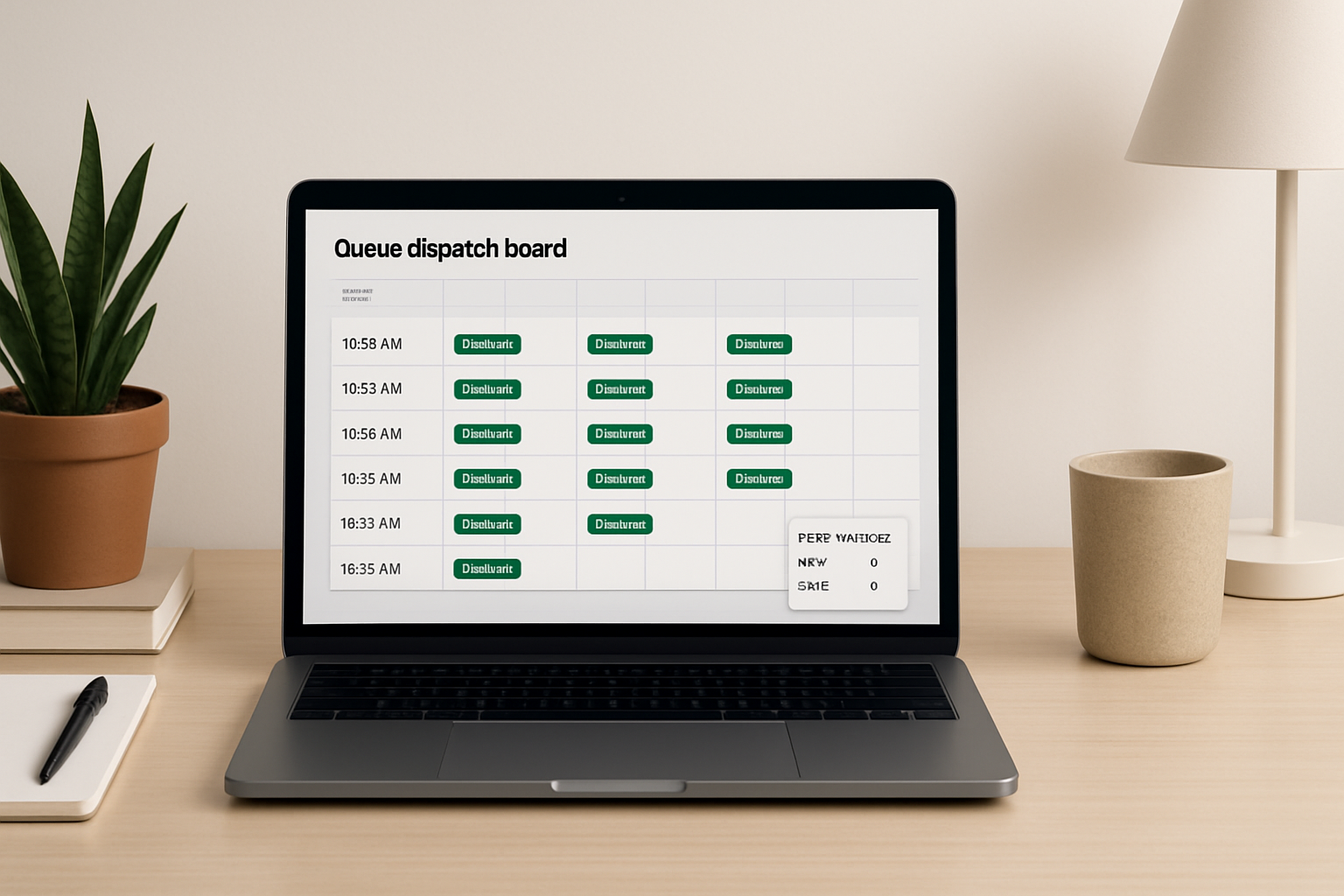
Fixed delays produce synchronized recovery. If twenty parallel workflows all hit a TPM limit at 14:03:22 and each one waits exactly five seconds, they all resume at 14:03:27 and immediately reproduce the same burst. The jitter in the function above spreads individual retries, but that only helps within a single process. When the retry logic lives inside a workflow orchestrator launching multiple parallel branches, each branch runs its own retry loop independently — and jitter per branch is not enough if all branches start from the same timestamp.
The more reliable approach is a shared queue with staggered dispatch. Instead of each workflow branch retrying on its own schedule, a central queue controls when calls get released back into the API. The queue tracks the current token consumption window and holds new dispatches until the available token headroom is above a safe threshold.
import asyncio
import time
from collections import deque
from dataclasses import dataclass, field
from typing import Callable, Awaitable, Any

@dataclass
class RateLimitedQueue:
    max_rpm: int = 60
    max_tpm: int = 90000
    dispatch_interval: float = 1.0   # seconds between dispatch cycles
    _queue: deque = field(default_factory=deque)
    _token_usage_window: list = field(default_factory=list)
    _request_times: list = field(default_factory=list)

    def _prune_window(self):
        now = time.monotonic()
        cutoff = now - 60.0
        self._request_times = [t for t in self._request_times if t > cutoff]
        self._token_usage_window = [
            (t, tok) for t, tok in self._token_usage_window if t > cutoff
        ]

    def tokens_used_last_minute(self) -> int:
        self._prune_window()
        return sum(tok for _, tok in self._token_usage_window)

    def requests_last_minute(self) -> int:
        self._prune_window()
        return len(self._request_times)

    def enqueue(self, coro_fn: Callable[[], Awaitable[Any]], estimated_tokens: int):
        self._queue.append((coro_fn, estimated_tokens))

    async def run(self):
        while True:
            if self._queue:
                coro_fn, estimated_tokens = self._queue[0]
                if (
                    self.requests_last_minute() < self.max_rpm
                    and self.tokens_used_last_minute() + estimated_tokens < self.max_tpm
                ):
                    self._queue.popleft()
                    now = time.monotonic()
                    self._request_times.append(now)
                    self._token_usage_window.append((now, estimated_tokens))
                    asyncio.create_task(coro_fn())
                else:
                    stagger = self.dispatch_interval + random.uniform(0, 0.5)
                    await asyncio.sleep(stagger)
                    continue
            await asyncio.sleep(self.dispatch_interval)
The key operational detail here is estimated_tokens. The queue needs a pre-call token estimate to decide whether there is room in the current TPM window before dispatching. A rough estimate based on input length — typically characters divided by four as a token approximation — is sufficient for most workflows. Getting this exactly right matters less than keeping the window tracking consistent across all dispatched jobs.
For a workflow processing roughly 50 concurrent document summarization calls, switching from per-branch retry loops to a shared queue typically reduces the number of 429 responses from several per minute to near zero during sustained load, because the queue absorbs the burst before it reaches the API rather than letting the API reject it and then recovering.
Monitoring Retry Patterns Without Drowning in Logs
Retry events are diagnostic signals. If a workflow is hitting RPM limits on more than about 10% of calls during normal operation, the queue's dispatch rate needs adjusting. If TPM limits dominate the 429 log, the per-call token budget is too large for the tier — either the prompts need trimming or the tier needs upgrading. If quota errors start appearing, the billing alert threshold was set too high and the daily cap was reached silently.
A lightweight counter that buckets retry reasons gives that visibility without requiring a full observability stack:
from collections import defaultdict
import json

retry_counters = defaultdict(int)
retry_log = []

def record_retry(workflow_id: str, limit_type: str, attempt: int, delay: float):
    retry_counters[limit_type] += 1
    retry_log.append({
        "workflow_id": workflow_id,
        "limit_type": limit_type,
        "attempt": attempt,
        "delay_seconds": round(delay, 2),
        "timestamp": time.time()
    })

def retry_summary() -> str:
    return json.dumps({
        "total_retries": sum(retry_counters.values()),
        "by_type": dict(retry_counters),
        "recent_events": retry_log[-10:]
    }, indent=2)
Call record_retry() inside the retry branches of call_openai_with_retry and expose retry_summary() on a health endpoint or write it to a log sink every five minutes. If by_type["tpm"] climbs above by_type["rpm"] by a factor of three or more during a processing run, that is a clear signal the token budget per call is the constraint — not the request frequency. That distinction changes whether the fix is throttling calls or compressing prompts.
The real ROI of this monitoring layer is that it surfaces the constraint type before it becomes a production incident, not after a missed SLA triggers a manual investigation.
Before and After: What the Failure Chain Actually Looked Like
Decision Tree: When to Retry vs Fail Fast
Not every 429 deserves a retry. Running through the decision once per error response keeps the logic tight and prevents workflows from burning time on unrecoverable states.
- Check
response.json()["error"]["type"]first. If it equals"insufficient_quota", stop immediately — raise an alert and exit the workflow. No retry will succeed until the billing quota resets or is increased. - If the error type is not quota exhaustion, read
x-ratelimit-remaining-requestsandx-ratelimit-remaining-tokens. A zero value in either field identifies which counter is exhausted and which reset header to use for the delay calculation. - If both remaining fields are non-zero and a 429 still fired, treat it as a transient server-side overload. Apply jitter backoff starting at a two-second base. If this pattern repeats more than three times without a zero remaining counter, log it separately — it is likely a 529 upstream issue, not a rate limit the client controls.
- If the response is a 500, 502, 503, or 529, apply jitter backoff with a longer base delay. These are server errors, not rate limit errors, and the retry logic should treat them as temporary infrastructure states rather than quota signals.
- For 400, 401, 403, and 404 responses, fail immediately. These are client errors that retry cannot fix — the request itself is malformed, unauthorized, or pointing at a nonexistent resource.
The one edge case that breaks this tree is when a workflow has a hard deadline — a webhook response timeout or a user-facing request with a five-second SLA. In those cases, the retry budget needs a wall-clock limit, not just an attempt count. Add a deadline parameter to the retry function and check time.monotonic() > deadline before each retry sleep. If the deadline passes, fail fast and surface the partial result or a graceful error rather than timing out the caller silently.
What This Does Not Solve
Header-aware retry logic handles transient rate limit events cleanly. It does not handle structural mismatches between the workflow's throughput requirements and the account's tier limits. If a workflow consistently needs to process 500 large documents per hour and the tier cap is 90,000 TPM, no retry strategy closes that gap — the tier needs to increase or the workflow needs to batch differently.
It also does not protect against prompt bloat accumulating across chained calls. A common failure pattern in multi-step workflows is that each step appends context to the next call, so token counts grow with each hop in the chain. By step five or six, a call that started at 800 tokens might be carrying 6,000 tokens of accumulated context — most of it redundant. The TPM limit fires not because the workflow is doing too much but because each individual call is carrying too much. The retry logic will keep handling the 429s, but the underlying token budget problem will keep reproducing them until the chain is redesigned to pass only the necessary state forward.
Queue-based dispatch also adds latency. For interactive use cases where a user is waiting on a response, holding a call in a queue for 15-30 seconds while the token window clears is not acceptable. The queue pattern is suited for background batch processing, not synchronous user-facing calls. Those need a different strategy — typically pre-warming the context, caching repeated sub-tasks, or routing to a tier with higher limits for the real-time path.
If the retry pattern is producing more than a handful of TPM hits per run, pull the retry summary and check the ratio. A TPM-dominant log almost always means the prompts feeding the chain are larger than necessary — and trimming them will do more than any backoff tuning.
Get the full retry implementation with queue runner, monitoring snippet, and fail-fast decision tree — join the list and it comes with the next workflow breakdown.