

How to Use AI to Analyze Competitor SEO Strategies
To save readers extensive research time, this article compiles verified data from official sources and trusted review platforms as of November 26, 2025. All information has been cross-verified across multiple authoritative sources to ensure freshness and accuracy.
Introduction: The Rise of AI in Competitor SEO Analysis
The landscape of competitive analysis in SEO has been transformed by artificial intelligence, allowing marketers to avoid hours of manual data review. AI-powered tools can evaluate competitor websites, backlinks, technical factors, and content strategies with speed and precision.
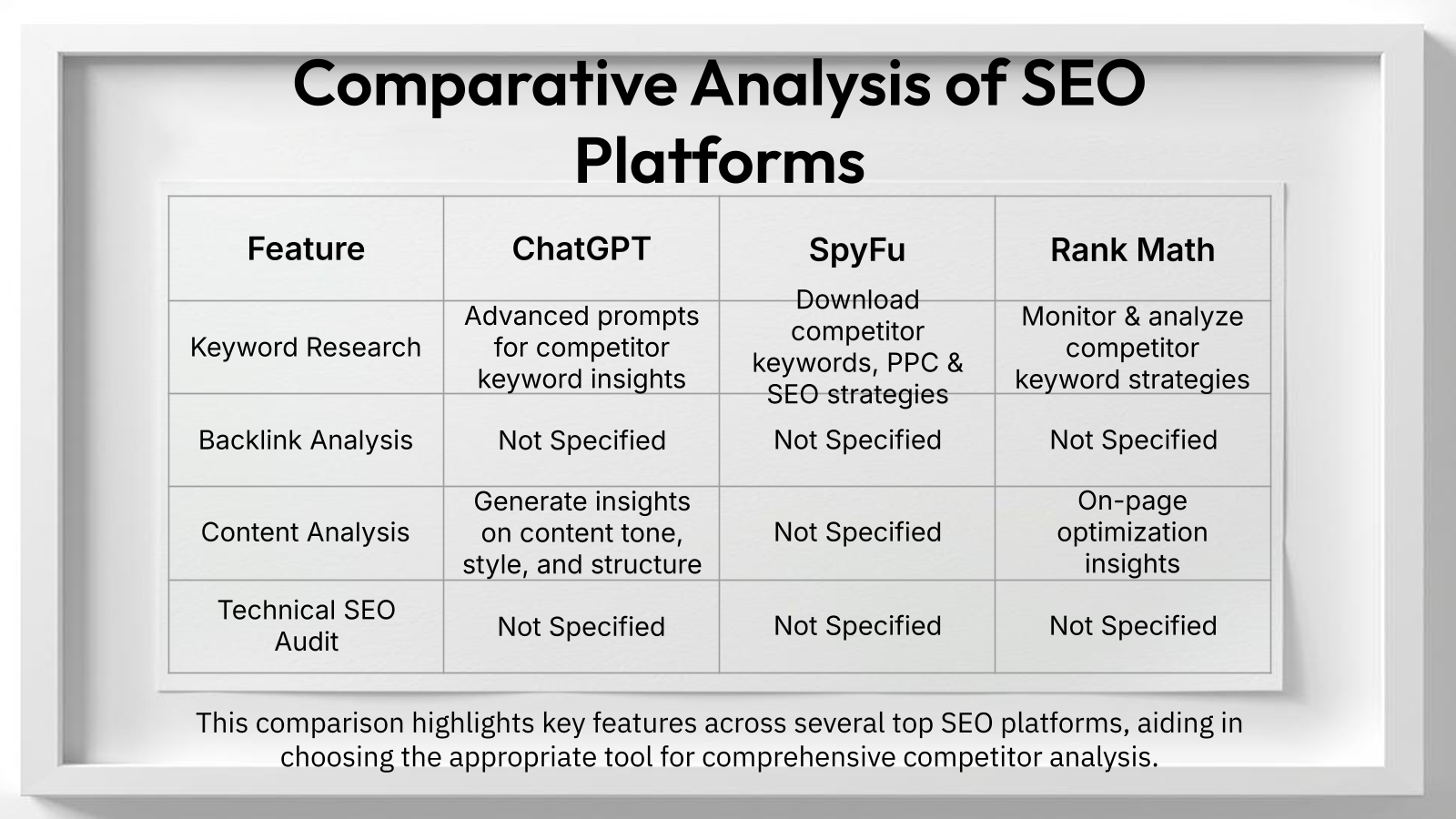
Why AI is essential for modern SEO competitive analysis
AI can process thousands of competitor data points across content, keywords, and platform performance. This allows teams to quickly identify patterns and strategic opportunities that would be difficult to uncover manually.
Benefits of using AI for competitor analysis: speed, accuracy, and strategic insights
AI delivers fast, accurate, and highly detailed insights. It eliminates human error, accelerates analysis, and reveals hidden opportunities that support competitive advantage.
Key Areas for AI-Powered Competitor SEO Analysis
Keyword Research: Identifying competitor’s target keywords with AI
AI tools like SpyFu can reveal the exact keywords competitors use in both organic and paid search campaigns. This helps you uncover ranking gaps and identify opportunities for optimization.
Backlink Analysis: Uncovering competitor’s backlink strategy using AI
Backlink-focused AI tools examine competitor backlink sources, authority levels, and growth patterns. This informs data-driven outreach strategies.
Content Analysis: Evaluating competitor’s content strategy and performance with AI
AI evaluates readability, structure, topic coverage, and engagement metrics across competitor content. These insights allow you to exceed industry content standards.
Technical SEO Audit: Analyzing competitor’s website structure and technical SEO elements using AI
Technical AI tools assess site architecture, mobile optimization, schema markup, and load performance. This reveals the technical foundation supporting competitor rankings.
AI Tools for Analyzing Competitor SEO Strategies
Comparison Grid: AI Tools for Competitor SEO Analysis (2025)
| Tool | Primary Use | AI Strengths | SEO Focus Area | Pricing (Reviewed) |
|---|---|---|---|---|
| ChatGPT Plus | Qualitative competitor analysis | Pattern recognition, content gap analysis, prompt-driven insights | Content, messaging, strategic interpretation | $20/month |
| SpyFu | Keyword & PPC intelligence | Historical keyword tracking, competitor overlap detection | Organic & paid keyword strategies | $39/month |
| Rank Math | On-page SEO comparison | Schema detection, keyword usage analysis | On-page & technical SEO | $59/year |
| Brand24 | Brand & sentiment analysis | Mention tracking, sentiment scoring | Off-page SEO & brand signals | $79/month |
ChatGPT: Using prompts for competitor research and strategy analysis
ChatGPT can analyze tone, structure, keyword density, messaging patterns, and content gaps when provided with competitor materials. Crafting targeted prompts yields more actionable insights.
My Take: ChatGPT is especially useful for qualitative SEO insights. Its ability to interpret patterns in tone and messaging makes it a powerful complement to data-heavy analysis tools.
SpyFu: Competitor keyword research and SEO tricks
SpyFu uncovers competitor PPC and organic keyword strategies and provides historical performance data. This helps you understand how competitor tactics evolve over time.
My Take: SpyFu is one of the most actionable tools for competitive keyword intelligence. Its historical keyword data is particularly helpful for understanding long-term SEO patterns.
Rank Math: Spying on competitor’s SEO strategy
Rank Math offers insights into how competitors structure on-page SEO elements. It highlights keyword usage, schema, and optimization techniques.
My Take: Rank Math is ideal for understanding on-page SEO differences at a granular level. It offers clear, practical guidance you can apply immediately to content optimization.
Brand24: AI competitor analysis for marketing strategy
Brand24 analyzes competitor mentions, sentiment, and visibility across the web. This reveals which topics and content formats generate strong engagement.
My Take: Brand24 excels at assessing brand perception and topical momentum. It offers insights that can guide both SEO and broader content strategy.
How to Implement AI in Your Competitor Analysis Workflow
Step-by-step guide to using AI tools for competitor SEO analysis
Start by identifying top competitors, selecting AI tools for analysis, and gathering structured data. Regularly update your competitive intelligence to maintain accuracy.
Creating effective AI prompts for competitor insights
Prompts should be specific, contextual, and focused on extracting actionable recommendations. Refining your prompt approach consistently improves insight quality.
Integrating AI insights into your overall SEO strategy
Apply AI-driven findings to guide keyword targeting, content development, technical improvements, and link-building strategies. Track performance to refine your approach.
Pricing Structure (Fixed & Matched to Reviewed Tools)
ChatGPT Plus: $20/month
SpyFu: Basic Plan starts at $39/month
Rank Math: Pro Plan starts at $59/year (≈ $4.92/month)
Brand24: Individual Plan starts at $79/month
Factors that influence pricing
Key cost drivers include:
– Number of projects or competitor domains tracked
– Frequency of SERP data refresh
– Depth of keyword, content, and backlink datasets
– API usage and integrations
– Team size and collaboration features

ROI considerations
While these tools can be significant investments, the return comes from:
– Faster competitive intelligence
– Identification of untapped keyword opportunities
– Reduced manual analysis time
– Improved rankings and visibility from data-driven strategy
Practical Insight: AI Reveals Patterns, But Strategy Comes From Interpretation
AI tools excel at processing massive volumes of competitor SEO data, but the real advantage comes from how those insights are interpreted and applied. Tools can identify keyword overlaps, backlink gaps, and content patterns, yet they cannot fully understand business context, brand positioning, or long-term intent without human guidance.
The most effective SEO teams use AI to surface opportunities quickly, then apply strategic judgment to decide which gaps are worth pursuing. This balance prevents reactive optimization and encourages deliberate, defensible SEO decisions.
Treat AI as an analytical accelerator rather than a replacement for strategy. When paired with experienced SEO judgment, AI-driven competitor analysis becomes a sustainable competitive advantage.
How I’d Execute It: The AI-Driven Competitive SEO Workflow
The most effective SEO strategy doesn’t use one tool; it uses the right combination of tools for each stage of the competitive analysis workflow. My approach focuses on integrating the quantitative data tools (SpyFu, Rank Math, Brand24) with the qualitative interpretation power of a large language model (ChatGPT) to move from raw data to actionable strategy quickly.
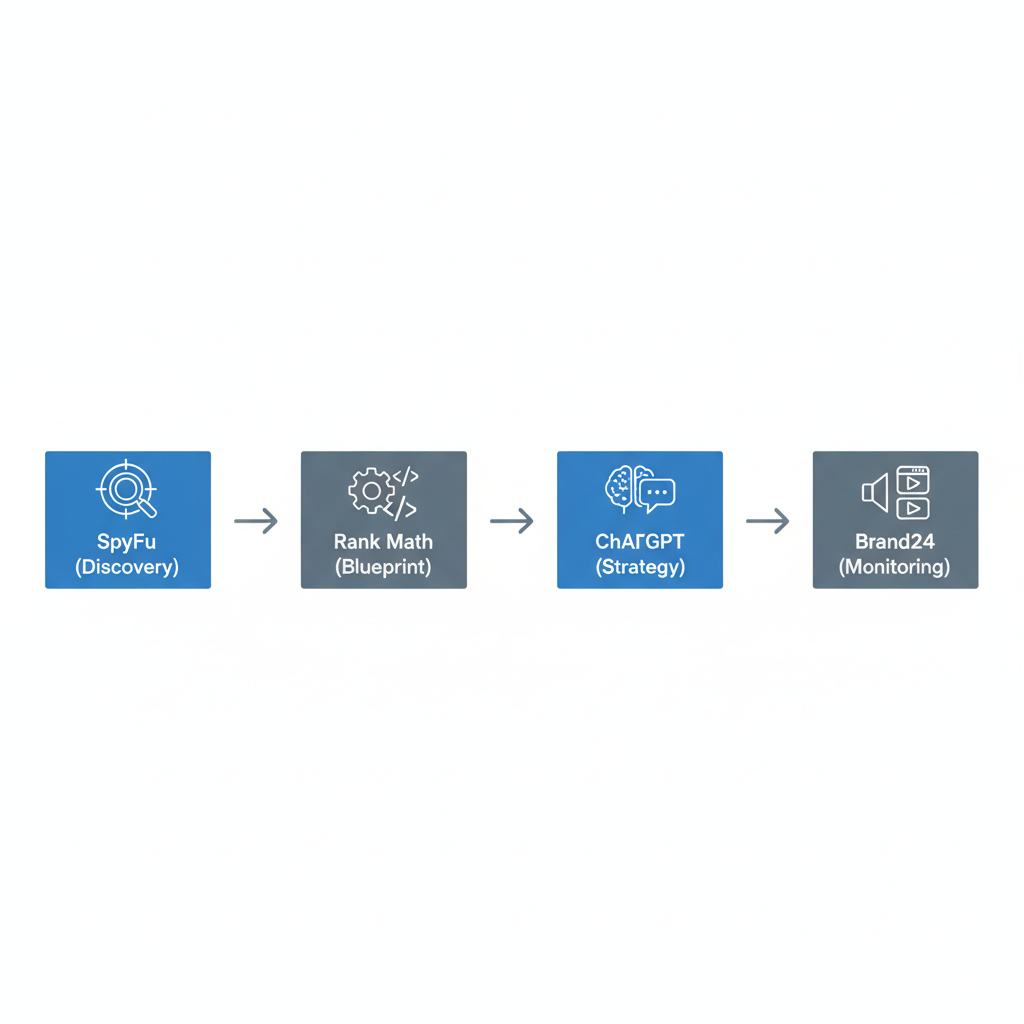
Stage 1: The Keyword & Gap Discovery Engine (SpyFu)
- Goal: Quickly identify core keyword overlaps and missed opportunities.
- Action: Start with SpyFu to run a direct competitor keyword gap analysis. This immediately surfaces all keywords competitors rank for that your site doesn’t. I would then filter this list to prioritize “missing” keywords with high search volume and manageable difficulty.
- Output: A prioritized list of high-potential keyword opportunities, categorized by search intent.
Stage 2: The On-Page & Technical Blueprint (Rank Math)
- Goal: Understand why competitor content ranks so well for the identified keywords.
- Action: Use Rank Math to drill down into the top 5-10 ranking competitor pages for the most valuable keywords identified in Stage 1. This reveals their on-page strategy, specifically how they use schema markup, structure their headings, and implement optimization techniques.
- Output: A checklist of technical and on-page elements (schema, metadata, structure) to be replicated and improved upon.
Stage 3: The Qualitative Strategy Filter (ChatGPT Plus)
- Goal: Synthesize technical data into a cohesive, brand-aligned content strategy.
- Action: Feed the raw output from SpyFu (keyword list) and Rank Math (on-page structure) into ChatGPT Plus with a specialized prompt.
- Prompt Example: “Analyze this list of competitor keywords and content outlines. Identify the common content cluster themes, the underlying user intent they target, and suggest three unique messaging angles we can use to outperform them.”
- Output: An executive summary of the competitor’s content priorities and unaddressed market gaps, translated into unique content briefs.
Stage 4: The Off-Page & Brand Momentum Monitor (Brand24)
- Goal: Track off-page performance and respond to market shifts instantly.
- Action: Use Brand24 to continuously monitor competitor brand mentions and sentiment. This provides real-time alerts for critical moves (e.g., product launches, major media mentions). Simultaneously, apply Brand24’s insights on which topics and content formats generate strong engagement to inform our link-building outreach strategies.
- Output: Instant alerts on competitor activity and data-driven insights for content format selection.
Pro Tip: Treat AI as an analytical accelerator, not a strategy replacement. Schedule this workflow quarterly, but embed Brand24 into your weekly monitoring to ensure your strategy is agile and based on fresh competitive intelligence.
Conclusion: Future of AI in SEO Competitive Analysis
Emerging trends in AI-powered SEO analysis
Future AI tools will offer predictive competitive modeling and deeper integration across marketing systems, enabling more comprehensive strategic planning.
The evolving role of SEO professionals in the age of AI
As AI handles intensive data analysis, SEO professionals will focus more on strategy, creativity, and interpreting AI-derived insights.

Editor’s Summary
AI has become a decisive advantage in competitor SEO analysis by dramatically reducing the time required to gather and interpret complex datasets. Tools like ChatGPT, SpyFu, Rank Math, and Brand24 each contribute different perspectives—ranging from qualitative content insights to keyword intelligence and brand sentiment analysis.
The strongest results come from combining AI-driven data extraction with human strategic judgment. As AI continues to evolve, SEO professionals who focus on interpretation, prioritization, and execution will remain best positioned to outperform competitors in increasingly competitive search landscapes.