
AI Video Generator for Explainer Videos
Introduction to AI Video Generators for Explainer Videos
AI video generators are sophisticated software tools that leverage artificial intelligence to automate and streamline the video creation process. These platforms transform text scripts into complete videos, including visuals, voiceovers, and music—all with minimal human intervention. For businesses across industries, explainer videos have become crucial marketing and educational assets, effectively communicating complex ideas in accessible, engaging formats.
The rise of AI in video content creation represents a significant shift in how businesses approach video production. What once required specialized skills, expensive equipment, and considerable time investment can now be accomplished with AI-powered platforms that democratize video creation for organizations of all sizes.
My Take: The emergence of AI video generators marks a transformative moment for content marketing, particularly for resource-constrained teams. Market consensus indicates these tools are rapidly maturing, offering increasingly sophisticated results while maintaining accessibility for non-technical users. The technology’s evolution has effectively lowered the barrier to entry for professional-quality explainer videos.
Core Features of AI Explainer Video Generators
Modern AI video generators offer several key capabilities that make them particularly valuable for creating explainer content:
- Text-to-video conversion: Transform written scripts directly into fully-formed videos, handling the visual storytelling automatically.
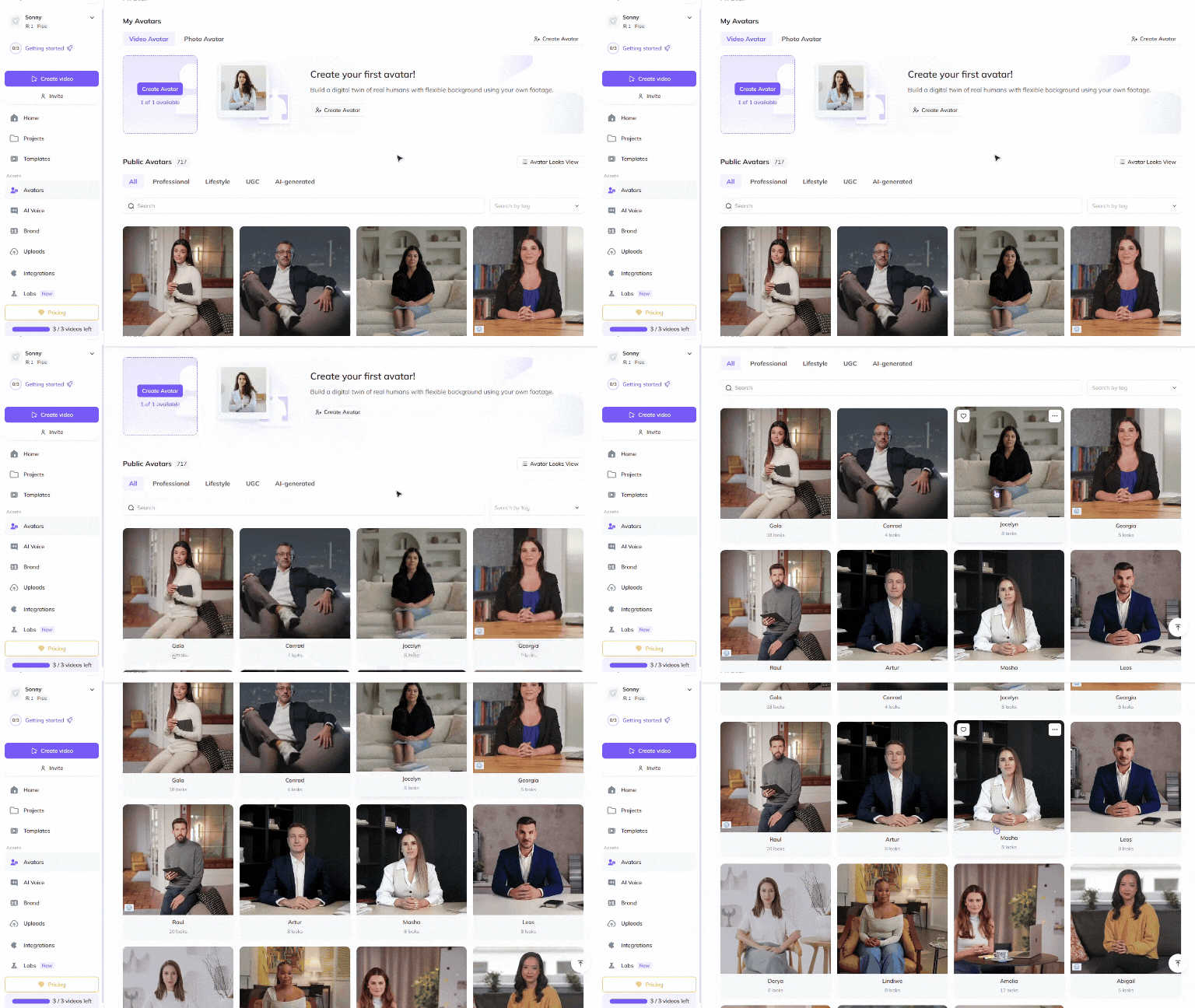
- AI avatars and digital presenters: Access a selection of realistic digital humans that can deliver narration on screen, eliminating the need for filming real presenters.
- Automated voiceovers: Generate natural-sounding narration in multiple languages and accents, with customizable voice styles to match your brand tone.
- Stock media libraries: Utilize extensive collections of pre-cleared footage, images, and music that the AI selects based on your script’s context.
- Brand customization: Upload logos, fonts, and color schemes to maintain consistent branding throughout your videos.
- Pre-designed templates: Choose from libraries of templates tailored for various explainer video styles and industry-specific needs.
- Automatic captioning: Generate subtitles and captions automatically, enhancing accessibility and engagement.
My Take: The comprehensive feature sets of these platforms represent a significant advancement over earlier video creation tools. The combination of AI avatars with multilingual capabilities addresses a critical pain point for global businesses seeking to scale content across markets. Users typically report that the template-based approach, while sometimes limiting creative freedom, dramatically accelerates production timelines.
Streamlining Your Workflow: How AI Simplifies Explainer Video Production
AI video generators have revolutionized the traditional video production workflow, condensing what was once a multi-week process into a matter of hours or even minutes. The typical workflow involves:
- Inputting a script or topic, which the AI converts into a video storyboard
- Selection of appropriate stock footage, images, and music from the platform’s library
- Addition of brand elements and customization of visual style
- Generation of voiceover narration using AI voice technology
- Final review, adjustments, and export in standard formats like MP4
This streamlined approach dramatically reduces both production time and costs. Marketing teams can rapidly iterate based on feedback, with AI-powered tools enabling quick adjustments without starting from scratch. For training and educational content, this efficiency means more frequent updates and a broader range of topics can be covered within existing resource constraints.
My Take: The workflow efficiency gains represent perhaps the most compelling aspect of these tools for business users. Reported outcomes indicate organizations can substantially reduce production timelines compared to traditional video creation methods. This acceleration enables marketing and training teams to experiment more freely with video content, testing different approaches without significant resource commitment.
Top AI Video Generators for Explainer Content
The market for AI video generators has expanded rapidly, with several platforms emerging as leaders in the explainer video space. Each offers distinct advantages depending on your specific needs:
Comparison of AI Video Generators for Explainer Videos
| Tool | Best For | Key Strength Mentioned in This Article | Starting Price | Free Plan |
|---|---|---|---|---|
| HeyGen | Presenter-led explainers | Realistic AI avatars, strong lip-sync, multilingual voice support | $29 / month | Yes |
| Synthesys | Avatar-driven explainers | AI presenters with natural movements and expressions | $20 / month | Yes |
| Pictory | Repurposing content into video | Turns long-form text into engaging videos with context-based visuals | $19 / month | Yes |
| InVideo | Template-first explainer production | Large explainer template library, strong customization, big stock library | $15 / month | Yes |
| Descript | Revision-heavy explainer workflows | Edit video by editing text; great for precise messaging | $16 / month | Yes |
| Lumen5 | Fast blog-to-video explainers | Converts articles into videos quickly; simple interface for rapid output | $19 / month | Yes |
HeyGen
HeyGen specializes in creating realistic AI avatars and presenters, making it particularly well-suited for professional explainer videos that benefit from a human touch. The platform offers advanced lip-syncing capabilities and a diverse range of avatar options, supporting multiple languages with natural-sounding voice generation.
Synthesys
Synthesys provides powerful text-to-video capabilities with a focus on AI-generated presenters. The platform excels in creating natural-looking avatar movements and expressions, making it suitable for more personalized explainer content where presenter authenticity matters.
Pictory
Pictory stands out for its ability to transform long-form content into engaging short videos. Its script-to-video functionality automatically selects relevant visuals based on textual context, making it ideal for quickly repurposing existing written content into explainer videos.
InVideo
InVideo offers an extensive template library specifically designed for explainer videos across various industries. The platform provides robust customization options and a large stock media library, balancing ease of use with creative flexibility.
Descript
Descript approaches video creation from a unique angle, treating video editing more like document editing. Its standout feature is the ability to edit the spoken word by simply editing text, making it particularly valuable for content that requires precise messaging and frequent revisions.
Lumen5
Lumen5 emphasizes simplicity and speed, with AI that can transform blog posts and articles into engaging videos automatically. Its intuitive interface and focus on quick turnaround make it accessible for teams without specialized video skills.
My Take: The differentiation between these platforms largely centers on their specialized strengths—HeyGen and Synthesys focus on realistic avatars, while Pictory and Lumen5 emphasize content transformation efficiency. Tool selection should be guided primarily by the specific explainer video style required and whether human-like presentation or rapid content scaling is the priority. Users often find that platforms with a clear specialization outperform broader “all-in-one” solutions for targeted use cases.
Who Benefits Most: Ideal Users and Use Cases
AI video generators for explainer content are particularly valuable for several key user groups:
- Marketing professionals and agencies: Create consistent, high-quality video content at scale for product launches, feature announcements, and social media campaigns.
- Small and medium-sized businesses (SMBs): Produce professional-quality video content without large budgets or extensive video production expertise.
- Educators and HR departments: Develop engaging training materials, course introductions, and lesson summaries that maintain viewer attention.
- Startups: Quickly create product demonstrations and pitch videos that effectively communicate value propositions to potential investors and customers.
These tools excel at specific use cases, including product demonstrations that showcase features and benefits, customer onboarding videos, internal training modules, and educational content that requires clear, concise explanation of concepts.
My Take: The most effective use of an AI video generator for explainer videos is in organizations with recurring, structured content needs. When teams align templates with standard formats like onboarding, feature overviews, or training updates, they can maintain consistent quality while freeing human creators to focus on strategy and higher-level creative direction.
Navigating the Landscape: Limitations and Considerations
While AI video generators offer impressive capabilities, potential users should be aware of certain limitations:
- Emotional range: AI avatars may lack the full range of nuanced human emotion and expression, which can be a trade-off for realism in more emotionally complex topics.
- Customization depth: While growing in sophistication, customization options might still be more limited compared to traditional video editing software.
- Visual uniqueness: The quality of visuals can sometimes appear generic if users heavily rely on default stock media without significant customization.
- Complex topic handling: Highly abstract or technically complex subjects may still benefit from human creative direction to ensure clarity.
Finding the right balance between AI efficiency and creative control remains an important consideration. Organizations should evaluate whether their specific content needs require the unique human touch that traditional video production provides, or if the speed and scale advantages of AI-generated content outweigh potential limitations in creative nuance.
My Take: The current limitations of these platforms are most apparent when content requires emotional depth or unique creative vision. Users generally report strong outcomes for straightforward, information-focused explainers, while flagship brand films or highly artistic campaigns still benefit from bespoke production. As capabilities evolve, it will remain important to match the tool to the strategic importance of each video.
The Future of Explainer Videos: Trends in AI-Powered Creation
The landscape of AI video generation is evolving rapidly, with several key trends shaping its future:
- Enhanced avatar realism: Recent advancements include more realistic AI voice cloning and improved lip-syncing for avatars, creating increasingly natural digital presenters.
- Generative AI integration: The incorporation of large language models is improving scriptwriting capabilities, helping users develop more engaging narratives automatically.
- Personalization capabilities: Emerging technologies are enabling dynamic content generation that can adapt to viewer preferences or demographics.
- Advanced editing features: More sophisticated platforms now allow for detailed scene-by-scene editing and fine-tuning of visual elements, giving users greater creative control.
These developments point toward a future where AI-generated explainer videos will continue to close the gap with traditionally produced content while maintaining their advantages in production speed and cost-effectiveness.
My Take: The trajectory of this technology suggests that an AI video generator for explainer videos will increasingly become a standard part of the content stack. As scripting, visual generation, and personalization converge, teams that establish clear guidelines and brand guardrails now will be best positioned to scale responsibly when more automation becomes available.
How I’d Use It: The “One-Man Agency” Workflow
If I were launching a new service alone and needed a professional explainer video, I wouldn’t hire an expensive agency. Instead, I would use HeyGen or InVideo.
Here is my specific strategy:
- Script from URL: I would paste my product’s landing page URL into the AI to automatically generate a script that highlights key features.
- Avatar Selection: I would choose a “friendly-looking” AI avatar to act as the narrator, giving the video a human touch without hiring an actor.
- Screen Recording Overlay: This is the pro tip. I would overlay actual screen recordings of my software while the AI avatar talks in the corner (Picture-in-Picture), rather than relying only on stock footage.
Bottom line: This method allows me to create a “Trustworthy” brand image that looks like it cost $5,000, but actually cost $30 and took 2 hours.
Pricing Plans
Below is the current pricing overview for the tools mentioned above:
- HeyGen: $29/mo, Free Plan Available
- Synthesys: $20/mo, Free Plan Available
- Pictory: $19/mo, Free Plan Available
- InVideo: $15/mo, Free Plan Available
- Descript: $16/mo, Free Plan Available
- Lumen5: $19/mo, Free Plan Available
Value for Money
When evaluating the value proposition of these AI video generators, it’s important to consider not just the monthly subscription cost, but the potential time and resource savings they offer. For small marketing teams or individual content creators, platforms like InVideo and Lumen5 provide exceptional value through their combination of affordability and robust feature sets. These tools effectively eliminate the need for specialized video production staff while still delivering professional-quality results.
For organizations that prioritize realistic human presenters, the slightly higher investment in platforms like HeyGen and Synthesys typically delivers strong returns through enhanced viewer engagement and perceived production quality. The value calculation shifts based on content volume—high-output teams often find that even premium-tier subscriptions represent significant savings compared to traditional video production costs, which can easily run into thousands of dollars per minute of finished content.
Editor’s Summary
AI video generators for explainer videos represent a significant technological advancement that balances efficiency with quality. The strongest platforms offer intuitive interfaces, diverse template libraries, and increasingly realistic AI avatars, though creative flexibility remains somewhat constrained compared to traditional production. These tools are best suited for organizations with consistent content needs, limited production resources, or requirements for rapid scaling across multiple languages and markets. While not yet a complete replacement for high-end custom video production, they provide exceptional value for routine explainer content, educational materials, and product demonstrations.