
Prompt Engineering Tools for Creative Writing
Understanding Prompt Engineering in Creative Writing
Prompt engineering for creative writing involves crafting specific instructions to guide AI models in generating desired narrative elements. This specialized approach helps writers communicate effectively with artificial intelligence to produce content that aligns with their creative vision.
For authors and content creators, prompt engineering has become essential as it provides a structured way to leverage AI capabilities while maintaining creative control. The primary audience includes novelists, screenwriters, short story authors, poets, and content creators focusing on narrative who seek to enhance their writing process.
The Core Principles of Effective Creative Prompting
Successful prompt engineering relies on several key principles:
- Specificity in describing desired outcomes
- Clear context setting for consistent AI responses
- Strategic use of examples to guide style and tone
- Iterative refinement to achieve desired results
My Take: Prompt engineering represents a fundamental shift in how creative professionals interact with technology. The most successful writers in this space develop a systematic approach to prompting that balances technical precision with creative flexibility. Market consensus indicates that mastering these core principles significantly improves output quality across all AI writing platforms.
Key Techniques and Strategies for Creative Prompts
Structuring Prompts for Narrative Depth and Character Development
Defining specific character personas within a prompt helps the AI generate dialogue and actions consistent with those characters. Effective prompt engineering can help maintain consistent character voices and narrative tones throughout a long-form project, creating more cohesive storytelling.
Using Iterative Prompting for Plot Refinement and World-Building
Iterative prompting, where output is refined through successive prompts, is a common workflow for developing complex story arcs. This approach allows writers to gradually build upon initial ideas, addressing inconsistencies and expanding promising elements through multiple prompt iterations.
Incorporating Style Guides and Tone Specifications
Advanced prompt engineering techniques can be used to experiment with different narrative styles or genres. By specifying stylistic elements like sentence structure, vocabulary preferences, and emotional tone, writers can guide AI to produce content that matches their unique voice.
My Take: The iterative approach to prompt engineering delivers the strongest results for creative writers. Users typically report that combining character-focused prompts with style specifications produces the most authentic-feeling output. The market increasingly favors tools that support this workflow through features like conversation memory and style preservation.
Top Prompt Engineering Tools and Platforms for Writers
Several AI platforms have emerged as valuable resources for creative writers seeking to leverage prompt engineering in their work. Each offers distinct capabilities designed to support different aspects of the creative process.
Prompt engineering tools for creative writing at a glance
Comparison based on pricing entry points, creative workflow fit, and prompt management support.
| Tool | Starting price | Free plan | Best for | Key strength |
|---|---|---|---|---|
| ChatGPT | $20/mo | Yes | Versatile ideation | Flexible prompting with strong context handling |
| Sudowrite | $19/mo | Yes | Novelists and storytellers | Fiction-first tools for brainstorming and rewriting |
| NovelAI | $10/mo | No | Long-form fiction | Narrative-focused generation and continuity control |
| AIPRM for ChatGPT | $5/mo | Yes | Prompt templates | Prompt library and repeatable frameworks |
| Jasper | $59/mo | Yes | Commercial storytelling | Structured templates and team workflows |
| Copy.ai | $29/mo | Yes | Short-form narrative content | Fast drafting for varied creative formats |
Tip: Fiction writers often get the best results by combining a general assistant with a specialized storytelling tool.
General AI Writing Assistants with Strong Prompting Features
ChatGPT provides a versatile platform for creative exploration with its conversational interface and strong contextual understanding. Jasper AI and Copy.ai offer more structured approaches with templates specifically designed for creative writers and marketers creating narrative content.
Specialized AI Tools for Novelists and Storytellers
Tools like Sudowrite offer features specifically designed for creative writers, such as ‘Brainstorm’ and ‘Rewrite’ functions driven by sophisticated prompting. NovelAI specializes in long-form fiction generation with fine-tuned models that understand narrative structure and character development.
Browser Extensions and Prompt Marketplaces
Some prompt engineering aids exist as browser extensions (e.g., AIPRM) that integrate directly with large language models like ChatGPT. These tools provide access to prompt templates and frameworks to assist users in structuring their creative inputs.
My Take: Specialized tools like Sudowrite and NovelAI demonstrate performance that many fiction writers consider well-aligned with narrative-focused workflows. General platforms like ChatGPT offer broader versatility but typically require more prompt engineering expertise. The integration capabilities of browser extensions like AIPRM can provide workflow advantages for writers who already use mainstream AI platforms.
How to Choose the Right Tool for Your Creative Workflow
When selecting a prompt engineering tool for creative writing, consider how it aligns with your specific writing needs. Short-form content creators may benefit from different features than novelists working on complex, character-driven narratives.
Many creative writers utilize a ‘human-in-the-loop’ workflow, where AI generates drafts and the human refines and edits. The ideal tool should complement this approach, offering intuitive interfaces that minimize the learning curve while providing sufficient depth for creative exploration.
Consider how each platform integrates with your existing writing process, including compatibility with word processors, note-taking apps, or publishing platforms you already use.
My Take: Tool selection should prioritize alignment with specific creative goals rather than feature abundance. Writers focusing on character-driven narratives may favor specialized platforms like Sudowrite, while those producing varied content across multiple formats often benefit from the flexibility of general platforms like ChatGPT with prompt management extensions. Integration with existing tools is an important factor for long-term satisfaction.
Limitations and Ethical Considerations
AI models may ‘hallucinate’ facts or create illogical plot points if not carefully guided by precise prompts. Additionally, AI models can sometimes produce generic or predictable content if prompts are not sufficiently detailed and nuanced.
A significant trade-off is the potential for AI-generated content to lack true originality or a unique human ‘voice’. This highlights the importance of using these tools as collaborators rather than replacements for human creativity.
Writers must also navigate concerns around originality, bias in AI outputs, and evolving copyright questions surrounding AI-assisted creative work.
My Take: The limitations of current AI systems represent both technical challenges and creative opportunities. Implementations that treat AI as a collaborative tool rather than an autonomous creator tend to align best with current capabilities. Platforms that communicate model limitations clearly and provide controls to manage hallucinations and generic output support more responsible use.
The Future of AI in Creative Writing and Prompt Engineering
A growing trend involves prompt chaining, where multiple prompts are linked to achieve more complex narrative outcomes. This technique allows for more sophisticated storytelling by breaking down complex creative tasks into manageable components.
Emerging technologies like multimodal prompting (combining text with images or audio) and agentic AI (systems that can take more autonomous actions within defined parameters) promise to further expand creative possibilities.
As these technologies evolve, the role of the writer is shifting toward becoming a creative director who guides AI collaborators rather than producing every word manually.
My Take: The trajectory of AI writing tools points toward increasingly collaborative workflows between human creativity and machine capabilities. Prompt chaining is a particularly practical development for structuring complex stories. Tools that make these techniques accessible without adding excessive complexity are well-positioned to support creative writers.
Maximizing Your Creative Potential with Prompt Engineering
Writers use prompt engineering to overcome writer’s block by generating new ideas for plots, characters, and settings. Prompt engineering is also utilized to generate detailed descriptions for scenes, environments, and character appearances.
Developing a personal prompting strategy involves identifying your specific creative challenges, experimenting with different prompting techniques, and building a library of effective prompts that you can refine over time.
My Take: Successful implementation of prompt engineering requires both technical understanding and creative intuition. Writers who develop systematic approaches to prompt creation while remaining open to unexpected AI outputs often report strong creative benefits. Prompt engineering is emerging as a complementary skill set alongside traditional writing craft.

How I’d Use It
When using prompt engineering tools for creative writing, I treat the AI as a collaborator that helps expand options—not as the source of final voice. The goal is to speed up ideation and iteration while keeping narrative control with the writer.
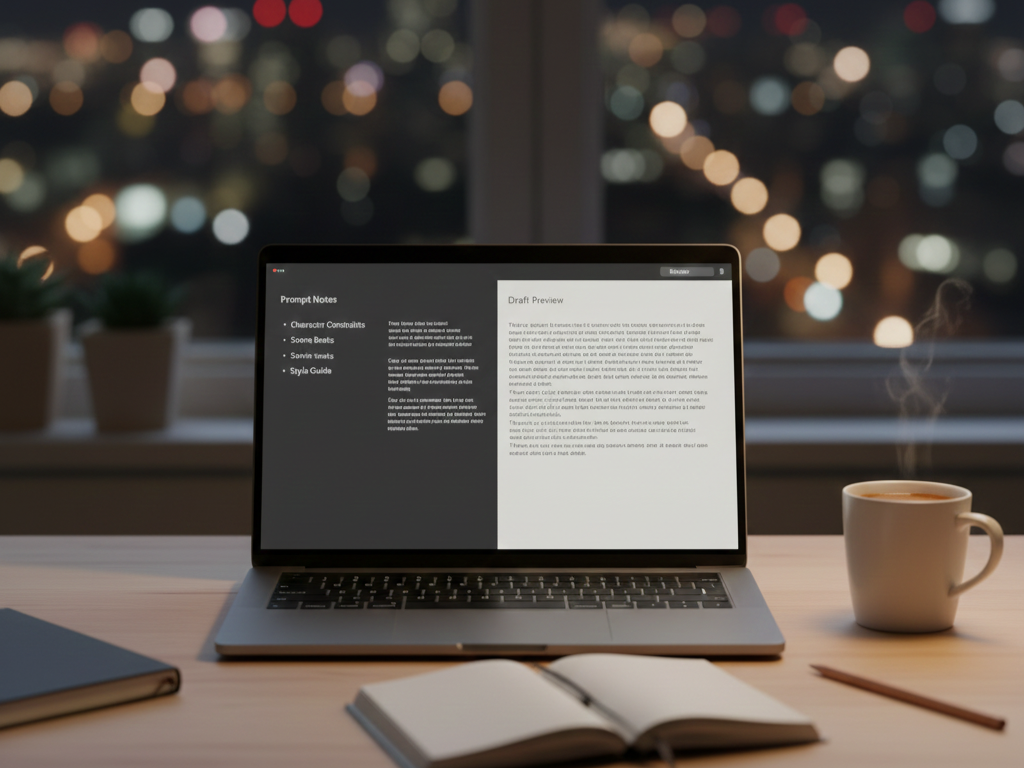
I start with a clear creative brief in the prompt. This includes genre, point of view, tense, tone, audience, and a short “do-not-break” list such as character personality constraints, world rules, and banned plot devices. These constraints reduce drift and improve consistency across outputs.
For long-form projects, I split prompting into stages. I prompt for character voice, then scene beats, then dialogue passes, then sensory description, rather than generating everything in one request. This “prompt chaining” approach produces cleaner structure and reduces random plot leaps.
I use iterative prompting to refine—not to chase perfection. If an output is close, I prompt with targeted adjustments: tighten pacing, increase subtext, make dialogue more distinct, or deepen setting detail. The best results come from focusing the model on one improvement per iteration.
Before keeping any AI output, I run a voice check. If the language feels generic, I rewrite key lines in my own style, then re-prompt with that excerpt as a style anchor. This protects originality and helps the AI mirror the writer’s cadence without overpowering it.
In practice, prompt engineering works best when it produces multiple strong directions quickly, while the writer remains the final editor and creative director.
Pricing Plans
Below is the current pricing overview for the tools mentioned above:
- ChatGPT: $20/mo, Free Plan Available
- Jasper AI: $59/mo, Free Plan Available
- Sudowrite: $19/mo, Free Plan Available
- AIPRM for ChatGPT: $5/mo, Free Plan Available
- NovelAI: $10/mo, No Free Plan
- Copy.ai: $29/mo, Free Plan Available
Value for Money
When evaluating value proposition, specialized tools like Sudowrite and NovelAI offer compelling benefits for dedicated fiction writers. These platforms provide narrative-specific features that justify their cost for serious authors working on long-form projects. Their focused development on creative writing use cases typically results in higher-quality output for fiction compared to general-purpose AI tools.
For writers with diverse needs or those just beginning to explore AI assistance, ChatGPT with AIPRM represents an excellent entry point. This combination provides access to powerful language capabilities with the added benefit of prompt management at a relatively modest investment. Meanwhile, platforms like Jasper AI and Copy.ai position themselves for professional content creators who need reliable output across multiple formats and can justify higher subscription costs through commercial application.
Editor’s Summary
Prompt engineering tools for creative writing are reshaping how authors ideate, draft, and refine stories. By learning to structure prompts, iterate on outputs, and select tools that match their narrative goals, writers can enhance productivity while preserving a distinct human voice. Specialized fiction platforms, general assistants with prompt extensions, and thoughtful human-in-the-loop workflows together enable AI to function as a collaborative partner rather than a replacement for creative judgment.