
The posts looked fine. Structure was clean, the writing was coherent, the topics were relevant. Published, indexed, sitting in Search Console with impressions.
No clicks.
The first instinct is to blame the algorithm. Maybe Google is downranking AI content. Maybe the site needs more authority. Maybe there’s a penalty somewhere that isn’t showing up cleanly in the data.
Wrong diagnosis. The real problem is upstream — and it has nothing to do with authorship.
Decision Snapshot
Best for: Site owners who have published AI content at volume and are watching impressions climb while clicks stay flat.
Avoid if: Your content isn’t indexed yet — intent mismatch is not your problem at that stage.
Reality: Fixing intent mismatch takes rewriting, not tweaking. A title change will not save a structurally wrong post.
Verdict: Most AI content fails at the intent layer, not the quality layer. That’s a harder fix — and a more fixable one.
The Misdiagnosis That Wastes Months
When content ranks but doesn’t get clicked, the visible explanation is usually a technical one. Bad title. Weak meta description. Competitive SERP. And those things can matter.
But there’s a layer underneath that most site owners don’t check: whether the content is actually targeting the right intent type for the keyword.
Google doesn’t just index words. It reads the room. When someone types a keyword into search, the SERP reflects what Google believes the user actually wants to do — learn something, buy something, compare options, or navigate to a known destination. If the content doesn’t match that intent type, it gets impressions and no clicks. The page shows up. The user scrolls past it.
This is the pattern behind a lot of zero-click AI content. Not a penalty. Not an authorship flag. A fundamental mismatch between what the content offers and what the user was trying to do.
The 30-Second Click-Through Diagnostic
- The Ghost Impression: High impressions with zero clicks aren’t a “near miss”—they are a loud signal that your content is solving a problem the searcher doesn’t have.
- The Intent Gap: Why an “informational explainer” is the fastest way to get ignored by a user who is ready to “buy or compare.”
- SERP Mirroring: How a 5-minute manual check of the Top 5 results can save you 100+ hours of failed content scaling.
- Asset vs. Dead Weight: Learn to identify which posts are building your domain authority and which ones are just “compounding drag” on your crawl budget.
What the SERP Is Actually Telling You
Before rewriting anything, check what Google is already surfacing for the keyword. This is the fastest diagnosis available, and most people skip it.
Open an incognito window. Search the exact keyword you’re targeting. Look at the top five organic results. Ask one question: what format and intent type are they serving?
If the top results are:
- Listicles and “best of” roundups → the intent is commercial or navigational
- Step-by-step guides → the intent is informational with a task outcome
- Product pages or comparison posts → the intent is transactional
- Forum threads, Reddit, or Q&A formats → the intent is exploratory or opinion-based
Now look at your content. If you wrote a 2,000-word informational explainer for a keyword where every top result is a comparison card or a buying guide, you have a structural mismatch. The content may be technically accurate. It’s still wrong for that slot.
This check takes under five minutes. It’s more useful than most SEO audits.
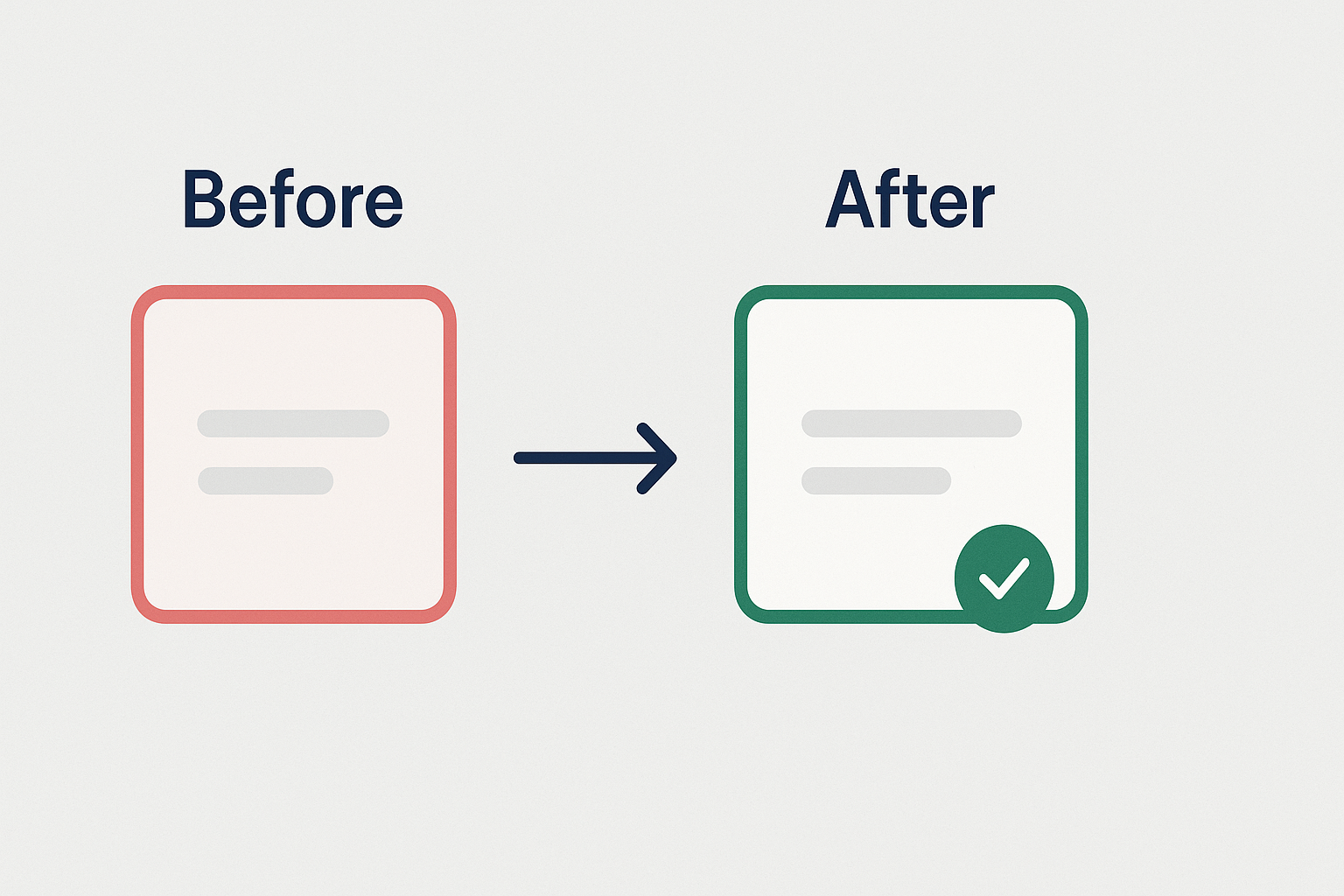
The Before/After That Actually Shows the Problem
Here’s the pattern in its clearest form.
Before: A post targeting a keyword like “best project management tools for small teams” is written as a neutral explainer — what project management is, why teams need it, general features to look for. Well-written. Comprehensive. Zero commercial signal. No comparison. No recommendation.
The SERP for that keyword is dominated by comparison posts with clear winners, affiliate-friendly breakdowns, and direct product links. The user who types that phrase is not looking to understand project management. They’re trying to pick a tool today.
Result: impressions, no clicks. The page exists. The user ignores it.
After: The same post is restructured as a direct comparison. Specific tools, clear criteria, a stated recommendation based on team size and use case. No hedging. The opening paragraph matches the user’s actual state: “You need to pick something this week. Here’s what to look at.”
Same keyword. Same site. Different intent alignment. The clicks follow.
This isn’t about AI content specifically. It’s about what happens when content is written without checking what the user actually came to find. AI scales the problem because it makes it easy to publish a hundred posts that are all technically correct and all intent-mismatched.
Why AI Makes This Worse at Scale
The default output of most AI writing workflows is informational. Give an AI a keyword and a brief, and it will produce an explainer. Well-structured, reasonably accurate, completely neutral. It answers “what is this” when the user was asking “which one should I use.”
At one post, that’s a fixable mistake. At a hundred posts, it’s a content architecture problem. The entire site skews toward informational intent when a significant portion of the target keywords are commercial or transactional.
Google reads the site-level pattern. A site where nearly every post is an explainer starts to look like an educational resource — which is fine, unless you’re trying to rank for “best X for Y” or “X vs Y” queries. Those queries have different user expectations, and Google routes them to pages that match.
The liability isn’t the AI. The liability is publishing volume without checking intent at the keyword level first.
The Profit Angle
You don’t have a content volume problem. You have a silent inventory of posts that look like assets on a spreadsheet but function as dead weight in search. Every intent-mismatched post isn’t neutral — it’s a compounding drag on the pages around it.
The Intent Audit: What to Actually Do
This isn’t a full SEO overhaul. It’s a triage process. Start with the posts that have the most impressions and the lowest CTR. Those are the clearest cases of intent mismatch — Google thinks the content is relevant enough to surface, but users disagree when they see it.
Intent Audit — Triage Breakdown
Step 1 — Pull the data: Search Console → Performance → sort by Impressions descending, filter for CTR under 2%
Step 2 — SERP check: Search each keyword in incognito. Identify the dominant intent type from the top 5 results.
Step 3 — Classify the gap: Is your content informational when the SERP wants commercial? Neutral when the SERP wants opinionated? Broad when the SERP wants specific?
Step 4 — Rewrite or redirect: If the gap is structural, rewrite. If the keyword is genuinely wrong for the site’s positioning, consider no-indexing the post and consolidating the topic elsewhere.
The goal is not to fix every post. The goal is to identify the cluster of high-impression, low-click pages and decide which ones are worth rewriting versus which ones are simply targeting the wrong keywords for what the site actually does.
What Rewrites That Actually Work Look Like
The fix isn’t adding more words. The fix is changing what the post is trying to do.
An informational post that should be commercial needs to make a call. It needs to compare options with a stated preference. It needs to tell the user what to do, not just what exists. Neutrality is the enemy of transactional intent.
One pattern that consistently improves intent alignment: add proprietary framing. Not fake data, but a clear point of view that only this site can offer. A recommendation with stated criteria. A verdict based on a specific use case. Something the user can’t get from a Wikipedia-style summary.
That’s what “utility” actually means in this context. Not length. Not comprehensiveness. Specific usefulness for the user’s actual decision state.
Google rewards utility and intent-alignment. A 600-word post that tells a user exactly what to do in their situation will outperform a 2,500-word explainer that covers everything except the decision they came to make.

What This Does Not Solve
Fixing intent mismatch will not save a post that’s targeting a keyword with no viable organic opportunity. If the SERP is dominated by AI Overviews or zero-click answer boxes, no amount of intent alignment will drive meaningful clicks. That’s a keyword selection problem, not a content quality problem.
It also won’t fix thin content that happens to be correctly intent-matched. If the post is commercial-intent but the comparisons are shallow, the recommendations are vague, and there’s nothing a user couldn’t find in thirty seconds elsewhere, the correct intent type won’t be enough.
And it won’t accelerate indexing. If posts aren’t surfacing in Search Console at all, the problem is earlier in the pipeline — crawling, internal linking, or domain authority — and intent is irrelevant until those are resolved.
Intent alignment is the middle layer. It matters after the content exists and is indexed. It matters before you’ve earned enough authority to rank regardless of format.
Get the Intent Audit Workflow
The Edge sends one practical breakdown per week — no filler. Next issue covers the exact Search Console filter sequence for finding your highest-leverage rewrite candidates.
Before You Go
A thousand AI posts don’t fail because Google hates AI — they fail because no one checked what the user was actually trying to do before the content was written. At scale, intent mismatch isn’t a content problem. It’s a publishing system that mistakes output volume for strategy.